Cups to ML (Milliliters) Conversion Chart
Never guess kitchen measurements again! Perfect for following international recipes and converting between US, Metric, and Imperial cups. Browser print is free, plus one PDF or PNG download daily without signup.
Quick answer
Quick answers: cups to ml for common recipe fractions
Using a US cup, 1 cup is about 236.588 ml, which this page rounds to 237 ml for kitchen use.
1/8 US cup
≈ 30 ml
1/3 US cup
≈ 79 ml
2/3 US cup
≈ 158 ml
3/4 US cup
≈ 177 ml
1 3/4 US cups
≈ 414 ml
Need another cup standard? A metric cup is 250 ml. An Imperial cup is 284 ml. Always match the cup system used by your recipe.
Preview & Download
Baking • 0.125-4 • 1 page • portrait
ChartsPrintables.com
Cups to ML Conversion Chart (US)
1 US cup = 236.588ml • 1/8-4 cups
| Cups | Milliliters (ml) | Tbsp | Tsp | fl oz |
|---|---|---|---|---|
| 1/8 | 30 | 2 | 6 | 1 |
| 1/4 | 59 | 4 | 12 | 2 |
| 3/8 | 89 | 6 | 18 | 3 |
| 1/2 | 118 | 8 | 24 | 4 |
| 5/8 | 148 | 10 | 30 | 5 |
| 3/4 | 177 | 12 | 36 | 6 |
| 7/8 | 207 | 14 | 42 | 7 |
| 1 | 237 | 16 | 48 | 8 |
| 1 1/8 | 266 | 18 | 54 | 9 |
| 1 1/4 | 296 | 20 | 60 | 10 |
| 1 3/8 | 325 | 22 | 66 | 11 |
| 1 1/2 | 355 | 24 | 72 | 12 |
| 1 5/8 | 384 | 26 | 78 | 13 |
| 1 3/4 | 414 | 28 | 84 | 14 |
| 1 7/8 | 444 | 30 | 90 | 15 |
| 2 | 473 | 32 | 96 | 16 |
| 2 1/8 | 503 | 34 | 102 | 17 |
| 2 1/4 | 532 | 36 | 108 | 18 |
| 2 3/8 | 562 | 38 | 114 | 19 |
| 2 1/2 | 591 | 40 | 120 | 20 |
| 2 5/8 | 621 | 42 | 126 | 21 |
| 2 3/4 | 651 | 44 | 132 | 22 |
| 2 7/8 | 680 | 46 | 138 | 23 |
| 3 | 710 | 48 | 144 | 24 |
| 3 1/8 | 739 | 50 | 150 | 25 |
| 3 1/4 | 769 | 52 | 156 | 26 |
| 3 3/8 | 798 | 54 | 162 | 27 |
| 3 1/2 | 828 | 56 | 168 | 28 |
| 3 5/8 | 858 | 58 | 174 | 29 |
| 3 3/4 | 887 | 60 | 180 | 30 |
| 3 7/8 | 917 | 62 | 186 | 31 |
| 4 | 946 | 64 | 192 | 32 |
1 US cup = 236.588ml
Generated by ChartsPrintables.com • Free to use and share
Rows
32
Range
0.125-4
PDF File Size
≈0KB
Quality
300 DPI
Export Set
One setup, every version you need.
Kitchen conversion pack
A printable kitchen conversion set.
Join early access for cups, ml, grams, ounces and baking basics.
Visual quick reference
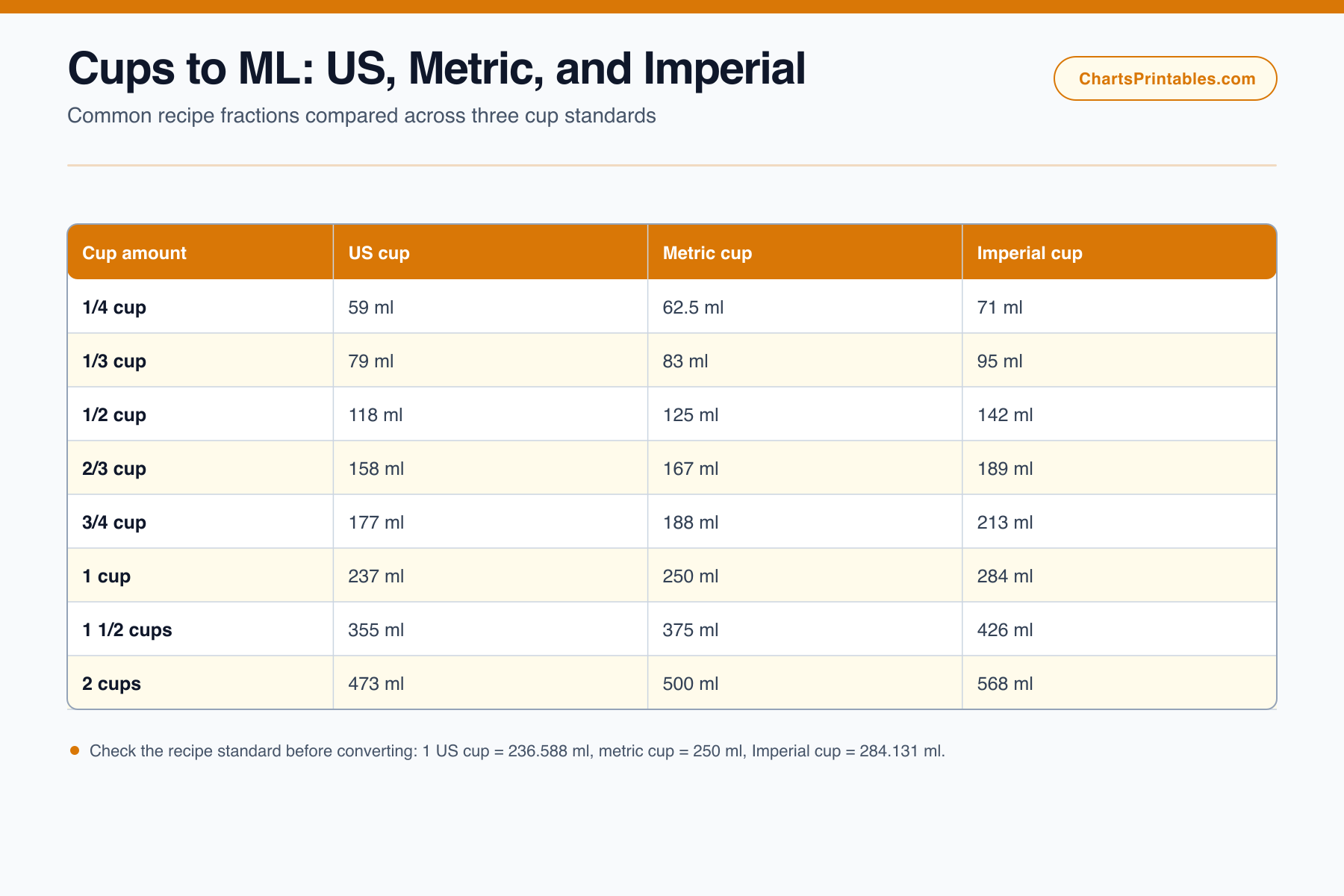
Cups to ML chart for US, metric, and Imperial cups
One US cup is about 237 ml, one metric cup is 250 ml, and one Imperial cup is about 284 ml.
Cup measurements are not universal, so identify the recipe standard before converting. The visual table compares common fractions from 1/4 cup through 2 cups across all three standards.
Global Cup Sizes Reference
Not all cups are created equal! Check your recipe's origin.
| Region | Cup Size (ml) | Notes |
|---|---|---|
| United States | 237 ml | Standard legal cup (8 fl oz) |
| Metric (Aus/NZ/UK) | 250 ml | Modern standard |
| Japan | 200 ml | Traditional "Gō" (rice cup) |
| Canada (Old) | 227 ml | ~8 fl oz (often rounded) |
| Traditional UK | 284 ml | 10 Imperial fl oz (rare now) |
Baking Pan Volume Capacities
Know how many cups of batter your pan holds to avoid overflow.
| Pan Size | Capacity (Cups) | Capacity (ML) |
|---|---|---|
| 8" Round Cake | 4-6 cups | ~1000-1400 ml |
| 9" Round Cake | 6-8 cups | ~1400-1900 ml |
| 9x13" Rectangular | 12-14 cups | ~2800-3300 ml |
| Standard Loaf (9x5) | 8 cups | ~1900 ml |
| 12-cup Muffin Tin | 3-4 cups | ~700-950 ml |
Visual Check: Liquid vs. Dry
Why you need two sets of measuring cups
💧 Liquid Measuring Cup
- Has a spout and handle for pouring
- Measurement lines are below the rim
- Why: So you don't spill while moving it to the bowl.
🥄 Dry Measuring Cup
- Flat top rim for leveling
- Designed to be leveled with a knife
- Why: To remove excess "heaped" ingredients for accuracy.
Understanding Cup Measurements
Not all cups are created equal! Learn the difference between US, Metric, and Imperial cups
US Cups (Standard)
237 ml
(236.588 ml exact)
The most common measurement in American recipes. This is what you'll find in most US cookbooks and online recipes.
Common in:
- United States
- Most English-language recipes
- Food blogs & YouTube channels
⚠️ Slightly smaller than metric cups (13ml difference)
Metric Cups
250 ml
(exact)
Used in countries that have adopted the metric system. The measurement is exactly 250 milliliters with no decimal conversion needed.
Common in:
- Australia & New Zealand
- Some Asian countries
- Modern metric cookbooks
💡 Simple conversion: 4 cups = 1 liter exactly
Imperial Cups (UK/Canada)
284 ml
(10 fl oz)
Less common today but still found in older British and Canadian recipes. Significantly larger than US cups.
Found in:
- Older UK/Canadian cookbooks
- Traditional British recipes
- Heritage cooking
⚠️ 47ml larger than US cups - significant difference!
Important: Always Check Your Recipe!
When following a recipe, check which cup measurement system it uses. The 14ml difference between US and Metric cups can affect baking results, especially for delicate recipes like cakes and pastries.
Rule of thumb:
- • US recipe? Use US cups (237ml)
- • Australian/NZ recipe? Use Metric cups (250ml)
- • Old British recipe? Check if it uses Imperial cups (284ml)
- • When in doubt? Use the country of origin as a guide
How to Use This Chart
Get accurate measurements every time with these simple tips
Measuring Liquids Correctly
- 1.Use a liquid measuring cup (clear cup with spout)
- 2.Place on a flat surface
- 3.Pour liquid to the measurement line
- 4.Check at eye level (bend down to see the line)
💡 Pro Tip:
The bottom of the curved liquid surface (meniscus) should align with the measurement line.
Measuring Dry Ingredients
- 1.Use a dry measuring cup (flat rim, no spout)
- 2.Spoon ingredient into cup (don't pack unless specified)
- 3.Level off with a straight edge (knife back)
- 4.Never shake or tap the cup
⚠️ Special Cases:
Brown sugar: Pack firmly
Flour: Spoon & level (never scoop)
Nuts/Chips:Don't pack
Printing & Laminating Tips
- Print at 100% scale
- Use cardstock or thick paper
- Laminate for water resistance
- Hang on kitchen wall or inside cabinet door
💡 Kitchen Hack:
Use clear contact paper or self-laminating sheets for DIY waterproofing. Wipes clean easily!
Common Cooking Conversions
Small Volumes (¼ cup and less)
| Cups | ML | Tablespoons | Teaspoons |
|---|---|---|---|
| 1/8 cup | 30 ml | 2 Tbsp | 6 tsp |
| 1/4 cup | 59 ml | 4 Tbsp | 12 tsp |
| 1/3 cup | 79 ml | 5⅓ Tbsp | 16 tsp |
Standard Measurements (½ cup to 4 cups)
| Cups | ML | Common Use |
|---|---|---|
| 1/2 cup | 118 ml | Liquid ingredients |
| 1 cup | 237 ml | Standard cup |
| 2 cups | 473 ml | 1 pint |
| 4 cups | 946 ml | 1 quart |
Large Batch Cooking (5+ cups)
| Cups | ML | Liters | Common Use |
|---|---|---|---|
| 8 cups | 1,893 ml | 1.9 L | Half gallon |
| 16 cups | 3,785 ml | 3.8 L | 1 gallon |
Baking Tips & Best Practices
📊When to Use Weights vs Volume
✅ Volume (Cups) work well for:
- • Liquids (water, milk, oil)
- • Everyday cooking
- • Quick recipes
- • Most American recipes
⚖️ Weight (Grams) better for:
- • Flour and dry ingredients
- • Professional baking
- • Precision recipes
- • Chocolate and candy making
🎯The Importance of Precision in Baking
Baking is a science! Unlike cooking, where you can adjust seasonings to taste, baking requires precise measurements. The ratio of flour to liquid to fat determines the texture and structure of your final product.
💡 Pro Tip:
For best results in baking, always measure flour by spooning it into the cup and leveling off. Scooping directly from the bag can pack up to 25% more flour than intended, resulting in dry, dense baked goods.
⚠️Common Baking Measurement Mistakes
Scooping flour directly
This compacts flour and adds too much. Always spoon and level.
Packing brown sugar when not specified
Most recipes specify "packed" or "unpacked" - follow instructions!
Using liquid cups for dry ingredients
Dry measuring cups allow you to level off; liquid cups don't.
Eyeballing measurements
Even experienced bakers measure - precision matters!
Related Kitchen Conversions
Use these related kitchen charts when a recipe switches between cups, ml, tablespoons, teaspoons, or ingredient weights.
| Tablespoons | Milliliters | Tsp | Cups | fl oz |
|---|---|---|---|---|
| 1/4 | 4 | 0.8 | 0.02 | 0.1 |
| 1/2 | 7 | 1.5 | 0.03 | 0.3 |
| 3/4 | 11 | 2.3 | 0.05 | 0.4 |
| 1 | 15 | 3 | 0.06 | 0.5 |
| 1.50 | 22 | 4.5 | 0.09 | 0.8 |
| 2 | 30 | 6 | 0.13 | 1.0 |
| 4 | 59 | 12 | 0.25 | 2.0 |
| 6 | 89 | 18 | 0.38 | 3.0 |
| 8 | 118 | 24 | 0.50 | 4.0 |
| 12 | 177 | 36 | 0.75 | 6.0 |
Tablespoons to ML
Convert tablespoons to milliliters with quick teaspoon cross-references for recipes.
| Teaspoons | Milliliters | Tablespoons |
|---|---|---|
| 1/4 | 1.2 | 0.08 |
| 1/2 | 2.5 | 0.17 |
| 3/4 | 3.7 | 0.25 |
| 1 | 4.9 | 0.33 |
| 1 1/2 | 7.4 | 0.50 |
| 2.00 | 9.9 | 0.67 |
| 2.50 | 12 | 0.83 |
| 3 | 15 | 1.0 |
| 4.00 | 20 | 1.3 |
| 6.00 | 30 | 2.0 |
Teaspoons to ML
Teaspoon-to-ml conversions with handy tablespoon equivalents for cooking and baking.
| Milliliters | Cups | Tbsp | Tsp | fl oz |
|---|---|---|---|---|
| 30 | 0⅛ | 2.0 | 6.1 | 1.0 |
| 50 | 0¼ | 3.4 | 10.1 | 1.7 |
| 75 | 0⅜ | 5.1 | 15.2 | 2.5 |
| 120 | 0½ | 8.1 | 24.3 | 4.1 |
| 180 | 0¾ | 12.2 | 36.5 | 6.1 |
| 200 | 0⅞ | 13.5 | 40.6 | 6.8 |
| 250 | 1 | 16.9 | 50.7 | 8.5 |
| 300 | 1¼ | 20.3 | 60.9 | 10.1 |
| 500 | 2⅛ | 33.8 | 101.4 | 16.9 |
| 750 | 3⅛ | 50.7 | 152.2 | 25.4 |
ML to Cups Chart
Convert milliliters to US, metric, and imperial cups for recipes and baking.
| Grams (g) | Ounces (oz) |
|---|---|
| 25 | 0.88 |
| 50 | 1.76 |
| 75 | 2.65 |
| 100 | 3.53 |
| 150 | 5.29 |
| 200 | 7.05 |
| 250 | 8.82 |
| 300 | 10.58 |
| 500 | 17.64 |
| 1000 | 35.27 |
Grams to Ounces
Weight conversion chart for kitchen recipes and ingredient prep.
Explore more: All Charts · Categories · Use Cases
Frequently Asked Questions
Why are there different types of cups?
Different countries adopted different standard cup sizes over time. US cups (237ml) are most common in American recipes, while metric cups (250ml) are used in Australia, New Zealand, and parts of Asia. Imperial cups (284ml) were used in older UK and Canadian recipes. The differences come from the historical development of measurement systems in each country.
How many ml in a cup?
It depends on which cup system: 1 US cup = 237ml (236.588ml exact), 1 Metric cup = 250ml (exact), 1 Imperial cup = 284ml. Most American recipes use US cups, which is the default in our charts.
How many ml is 1/3 cup?
1/3 US cup is about 79 ml. This uses the US cup standard of about 236.588 ml per cup, rounded for kitchen use.
How many ml is 2/3 cup?
2/3 US cup is about 158 ml. If your recipe uses metric cups, 2/3 metric cup is about 167 ml because a metric cup is 250 ml.
How many ml is 1 3/4 cups?
1 3/4 US cups is about 414 ml. The same amount in metric cups would be 437.5 ml, so check the recipe's cup system before baking.
Is a US cup 237 ml or 240 ml?
A US cup is exactly about 236.588 ml, commonly rounded to 237 ml on this chart. Some recipe sites round to 240 ml for simplicity, but metric cups are 250 ml and Imperial cups are 284 ml.
Can I use the same cup for liquids and dry ingredients?
Yes, but measuring technique matters! For liquids, fill to the line and check at eye level. Use a clear measuring cup with a spout. For dry ingredients, spoon into the cup and level off with a straight edge (don't pack unless recipe specifies). Best practice: Use dedicated liquid and dry measuring cups for most accurate results, especially in baking!
How do I convert a recipe from cups to ml?
Multiply cups by the appropriate conversion factor: For US recipes: cups × 237 = ml (Example: 2 cups = 474 ml). For Metric recipes: cups × 250 = ml (Example: 2 cups = 500 ml). Or simply use this chart to look up the conversion instantly! That's what it's for.
What if my recipe doesn't specify which cup to use?
Use the recipe's country of origin as a guide: US recipes - assume US cups (237ml), Australian/NZ recipes - assume Metric cups (250ml), UK recipes - modern recipes usually use metric; older recipes may use Imperial (284ml). When in doubt: If the recipe is from a US source, use US cups. If it's from Australia/NZ, use Metric cups.
Do I need a kitchen scale or can I just use cups?
It depends on what you're making. Cups are fine for everyday cooking, soups and stews, smoothies, and most liquids. A scale is better for baking, pastries, chocolate work, and precision recipes. This chart helps bridge both methods.
Still have questions about kitchen conversions?
We're here to help! Email us with your questions or feedback.
Email: support@chartsprintables.com