Fahrenheit to Celsius Chart: 370F to C, 380F to C & Oven Temps(°F to °C printable quick reference)
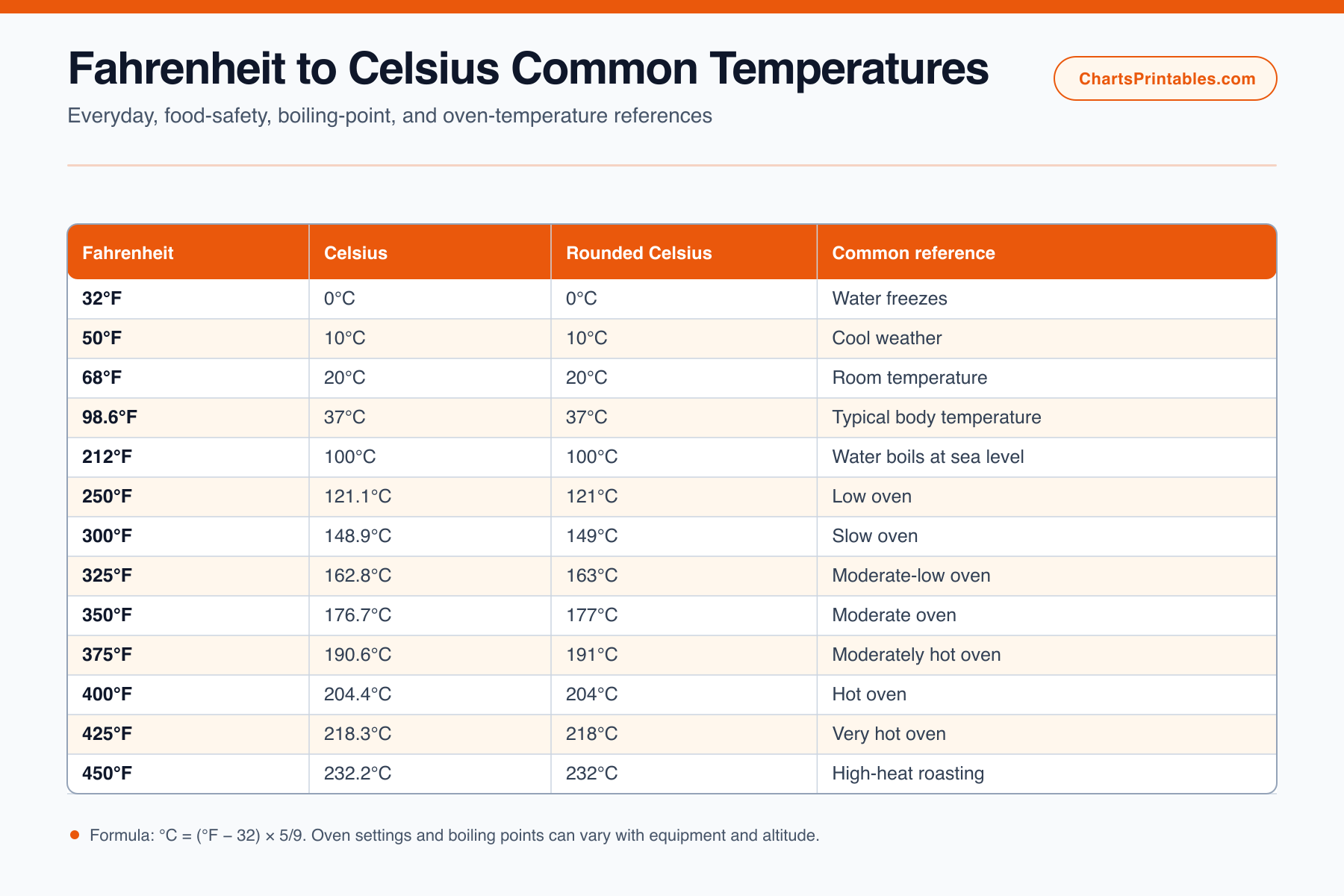
370°F is 187.8°C, usually rounded to 188°C. 380°F is 193.3°C, usually rounded to 193°C; 325°F is 162.8°C, usually rounded to 163°C.
Use this printable Fahrenheit to Celsius chart for oven temperatures, recipe conversions, weather, travel, and science references—then customize the range you need. Browser print stays free, and one PDF or PNG download is available daily without signup.
Quick answer
300F to C, 375F to C, and common oven temperatures
For quick oven and recipe checks: 300°F equals 148.9°C, about 149°C. 375°F equals 190.6°C, about 191°C; many oven charts round it to 190°C.
Low oven / 300f to c
300°F
Fahrenheit
148.9°C ≈ 149°C
Celsius
Moderate-hot oven / 375f to c
375°F
Fahrenheit
190.6°C ≈ 191°C
Celsius
Moderate oven
350°F
Fahrenheit
176.7°C ≈ 177°C
Celsius
Hot oven
400°F
Fahrenheit
204.4°C ≈ 204°C
Celsius
Water freezes
32°F
Fahrenheit
0°C
Celsius
Room temperature
68°F
Fahrenheit
20°C
Celsius
Body temperature
98.6°F
Fahrenheit
37°C
Celsius
Water boils
212°F
Fahrenheit
100°C
Celsius
Need baking conversions?
Jump to the oven section for 300°F, 350°F, 375°F, and 400°F equivalents, including exact Celsius values and common oven-chart rounding.
Oven temperature guideNeed weather benchmarks?
See freezing, cool, warm, and hot outdoor temperatures at a glance.
Weather guideNeed the printable chart?
Customize the range, pick a template, and download your chart in PDF or PNG format.
Preview & DownloadUse the full Fahrenheit to Celsius chart below to look up more temperatures, then customize the range and download a printable PDF or PNG for your kitchen, classroom, or workspace.
Preview & Download
Cooking & Baking • 200-500 • 1 page • portrait
ChartsPrintables.com
Fahrenheit to Celsius Conversion Chart
°F to °C (with Gas Mark) • Step 25°F
| Fahrenheit (°F) | Celsius (°C) | Gas Mark | Description |
|---|---|---|---|
| 200°F | 93°C | ||
| 225°F | 107°C | ¼ | Very slow oven |
| 250°F | 121°C | ½ | Very slow oven |
| 275°F | 135°C | 1 | Slow oven |
| 300°F | 149°C | 2 | Slow oven |
| 325°F | 163°C | 3 | Moderately slow |
| 350°F | 177°C | 4 | Moderate oven |
| 375°F | 191°C | 5 | Moderately hot |
| 400°F | 204°C | 6 | Hot oven |
| 425°F | 218°C | 7 | Hot oven |
| 450°F | 232°C | 8 | Very hot oven |
| 475°F | 246°C | 9 | Very hot |
| 500°F | 260°C | 10 | Extremely hot |
Formula: °C = (°F − 32) × 5/9
Generated by ChartsPrintables.com • Free to use and share
Rows
13
Range
200-500
PDF File Size
≈0KB
Quality
300 DPI
Export Set
One setup, every version you need.
Visual quick reference
Fahrenheit to Celsius chart for common temperatures
32°F is 0°C, 68°F is 20°C, 212°F is 100°C, and a 350°F oven is approximately 177°C.
The chart combines everyday temperatures and frequently used oven settings. Convert any other value with °C = (°F − 32) × 5/9, then round only to the precision the task requires.
🍬 Fahrenheit to Celsius Candy-Making Temperatures
Critical temperatures for sugar work and confectionary.
| Stage | Fahrenheit (°F) | Celsius (°C) | Result |
|---|---|---|---|
| Soft Ball | 235-240°F | 113-116°C | Fudge, Fondant |
| Firm Ball | 245-250°F | 118-121°C | Caramels |
| Hard Ball | 250-265°F | 121-129°C | Marshmallows, Nougat |
| Soft Crack | 270-290°F | 132-143°C | Taffy |
| Hard Crack | 300-310°F | 149-154°C | Lollipops, Brittle |
| Caramel | 320-338°F | 160-170°C | Caramel Sauce |
🖨️ Fahrenheit to Celsius for 3D Printing Filament
Nozzle temperatures for common materials.
| Material | Nozzle (°C) | Nozzle (°F) | Bed (°C) |
|---|---|---|---|
| PLA | 190-220°C | 374-428°F | 40-60°C |
| PETG | 230-250°C | 446-482°F | 70-80°C |
| ABS | 230-260°C | 446-500°F | 90-110°C |
| TPU | 210-230°C | 410-446°F | 30-60°C |
🥩 Fahrenheit to Celsius Sous Vide Temperatures
Precision cooking guides for perfect doneness.
| Doneness | Fahrenheit | Celsius | Texture |
|---|---|---|---|
| Rare | 120-128°F | 49-53°C | Cool red center |
| Medium Rare | 129-134°F | 54-57°C | Warm red center |
| Medium | 135-144°F | 57-62°C | Warm pink center |
| Medium Well | 145-155°F | 63-68°C | Slightly pink |
🔥 Fahrenheit to Celsius Oven Temperature Guide
The most common cooking and baking temperatures at your fingertips
Common Baking Temperatures
Low oven • Slow roasting
⭐ Most common • Cakes, cookies
Moderately hot • Quick breads
Hot oven • Roasting vegetables
Very hot • Pizza, artisan bread
Understanding Gas Marks
Gas Marks are used on gas ovens, primarily in the UK and Europe. Each mark represents approximately 25°F (14°C) increase.
💡 Fun Fact:Gas Mark 4 (350°F/177°C) is called "moderate oven" - the sweet spot for most baking!
Fan Oven Adjustments
Fan-assisted (convection) ovens circulate hot air, cooking food faster and more evenly.
📐 Conversion Rule:
Option 1: Reduce temp by 25°F (15°C)
Example: 350°F → 325°F fan
Option 2: Reduce time by 10-15%
Example: 60 min → 50-55 min
Recipe says 350°F conventional:
Recipe says 400°F conventional:
⚠️ Tip: Always verify with an oven thermometer - individual ovens can vary by ±25°F!
🌤️ Fahrenheit to Celsius Weather Guide
Understand what the temperature feels like when traveling or checking weather forecasts
Freezing
Water freezes, ice forms
Mild
Light jacket weather
Warm
T-shirt weather, comfortable
Hot
Stay hydrated, seek shade
How to Convert Fahrenheit to Celsius
The Formula
Example Calculation:
Problem: Convert 350°F to Celsius
Step 1: 350 - 32 = 318
Step 2: 318 × 5/9 = 176.67
Answer: ≈ 177°C (moderate oven)
Quick Mental Math Tricks
🧮Trick #1: Subtract 30, halve it
For rough estimates: (°F - 30) ÷ 2
(Actual: 37.8°C - close!)
📊Trick #2: Remember Benchmarks
Memorize key temperature points
212°F = 100°C (Boiling)
98.6°F = 37°C (Body temp)
Understanding Fahrenheit to Celsius Temperature Scales
Fahrenheit
Created: 1724 by Daniel Gabriel Fahrenheit
Used in: United States, Cayman Islands, Bahamas, Palau
Scale: Water freezes at 32°F, boils at 212°F (180° difference)
Best for: Daily weather (finer granularity for comfort range)
Celsius
Created: 1742 by Anders Celsius
Used in: Worldwide (except US and a few others)
Scale: Water freezes at 0°C, boils at 100°C (100° difference)
Best for: Science, international communication (metric system)
Why Different Scales Exist
Fahrenheit was designed with 0°F as the coldest temperature achievable with a brine solution, and 100°F as human body temperature (later refined to 98.6°F). This made sense for daily life in the 1720s.
Celsius was designed around water's freezing and boiling points, making it more logical for scientific work. Today, most of the world uses Celsius for its simplicity, while the US maintains Fahrenheit for historical and cultural reasons.
Related Fahrenheit to Celsius Charts
Keep converting with reverse temperature charts, oven temperature guides, and kitchen measurement references.
| Celsius (°C) | Fahrenheit (°F) | Notes |
|---|---|---|
| -40 | -40 | Extreme cold |
| -10 | 14 | Cold winter |
| 0 | 32 | Freezing |
| 10 | 50 | Cool day |
| 20 | 68 | Room temp |
| 25 | 77 | Pleasant |
| 30 | 86 | Warm |
| 40 | 104 | Hot |
| 50 | 122 | Very hot |
| 100 | 212 | Boiling |
Celsius to Fahrenheit
Essential temperature conversion chart for US travel, international cooking, and weather reference.
| °F | °C | Fan °C | Gas Mark | Use |
|---|---|---|---|---|
| 175 | 79 | 59 | - | Warm |
| 200 | 93 | 73 | - | Low roast |
| 225 | 107 | 87 | ¼ | Low & slow |
| 250 | 121 | 101 | ½ | Slow roast |
| 275 | 135 | 115 | 1 | Gentle bake |
| 300 | 149 | 129 | 2 | Baking |
| 325 | 163 | 143 | 3 | Roast light |
| 350 | 177 | 157 | 4 | Roast |
| 375 | 191 | 171 | 5 | Golden |
| 400 | 204 | 184 | 6 | Crisp finish |
Oven Temperature Guide
Oven temperature conversions including Gas Mark and fan adjustments.
| Celsius (°C) | Kelvin (K) | Notes |
|---|---|---|
| -273.15 | 0.00 | Absolute zero |
| -50 | 223.15 | — |
| 0 | 273.15 | Freezing point |
| 10 | 283.15 | — |
| 20 | 293.15 | Room temperature |
| 25 | 298.15 | Room temperature |
| 37 | 310.15 | Body temperature |
| 50 | 323.15 | — |
| 75 | 348.15 | — |
| 100 | 373.15 | Boiling point |
Celsius to Kelvin
Scientific temperature conversions for labs and engineering calculations.
| Cups | Milliliters | Tbsp | Tsp | fl oz |
|---|---|---|---|---|
| 1/4 | 59 | 4 | 12 | 2 |
| 1/3 | 78 | 5.3 | 15.8 | 2.6 |
| 1/2 | 118 | 8 | 24 | 4 |
| 177 | 12 | 36 | 6 | |
| 1 | 237 | 16 | 48 | 8 |
| 355 | 24 | 72 | 12 | |
| 2 | 473 | 32 | 96 | 16 |
| 3 | 710 | 48 | 144 | 24 |
| 4 | 946 | 64 | 192 | 32 |
| 6 | 1420 | 96 | 288 | 48 |
Cups to ML Chart
Kitchen measurement conversions for international recipes, baking, and coffee ratios.
Explore more: All Charts · Categories · Use Cases
Fahrenheit to Celsius FAQs
What is 300°F in Celsius?
In a Fahrenheit to Celsius chart, 300°F is 148.9°C, which rounds to 149°C. For broad oven charts, you may also see 150°C, but 149°C is the closer calculated conversion.
What is 375°F in Celsius?
A Fahrenheit to Celsius conversion gives 375°F as 190.6°C. Mathematically it rounds to 191°C, while some oven temperature charts round it to 190°C for cooking guidance.
Is 375°F 190°C or 191°C?
Both can appear in a Fahrenheit to Celsius chart. The exact conversion is 190.6°C, so 191°C is the nearest whole degree. Many oven charts use 190°C because oven settings are often rounded to the nearest 5°C or 10°C.
What is 350°F in Celsius?
For Fahrenheit to Celsius recipe conversion, 350°F is 176.7°C, usually rounded to 177°C. It is a common moderate oven temperature for cakes, cookies, and many baked goods.
What is 400°F in Celsius?
A Fahrenheit to Celsius chart shows 400°F as 204.4°C, usually rounded to 204°C. Some broad oven guides round it to 200°C, but 204°C is the calculated conversion.
How do I convert Fahrenheit to Celsius?
Use the formula °C = (°F - 32) × 5/9 for any Fahrenheit to Celsius conversion. For example, 300°F gives (300 - 32) × 5/9 = 148.9°C, and 375°F gives (375 - 32) × 5/9 = 190.6°C.
What are Gas Marks?
Gas Marks are temperature settings used on gas ovens, primarily in the UK and some European countries. Each mark represents approximately 25°F (14°C) increase. Gas Mark 4 ≈ 350°F (177°C), which is moderate oven temperature. Gas Mark 6 ≈ 400°F (200°C), which is a hot oven.
At what temperature are Fahrenheit and Celsius the same?
-40 degrees: -40°F = -40°C. This is the only point where the two temperature scales intersect.
Do I need to convert oven temperatures exactly?
For most home baking, rounding to the nearest 5°C is fine. Ovens typically vary by ±10-25°F anyway. However, for delicate items like soufflés or macarons, use the precise conversion and verify your oven's actual temperature.
Why do some recipes say '180°C fan'?
Fan-assisted convection ovens circulate hot air, cooking faster and more evenly. They are typically set 15-25°C (25-45°F) lower than conventional ovens. '180°C fan' is roughly equivalent to about 200°C conventional, or close to 400°F conventional ovens.
Still have questions?
We're here to help! Email us with your questions or feedback.
Email: support@chartsprintables.com