🪵
Woodworking
Essential for metric-plans or imported router bits. Convert bit depth instantly.
Convert millimeters to decimal inches and nearest tape-measure fractions. Use decimal inches for exact calculations and the fraction column for tape-measure or shop-floor reference.
Use the decimal value for machining or CAD. Use the nearest fraction when reading a tape measure, matching hardware, or marking a quick workshop cut.
Millimeters to inches in real-time, plus a reverse checker.
Example: 25.4 (Exactly 1 inch)
Approx: 1.0000" (1/1")
Exact Formula
inches = mm ÷ 25.4
1 inch is defined as exactly 25.4 millimeters.
Millimeters convert to exact decimal inches by dividing by 25.4, but most rulers, tape measures, drill bits, and hardware labels use fractional inch sizes. That means a value like 12mm has an exact decimal result (0.4724") and a practical nearest fraction (15/32"). For parts labeled with nominal sizes, always check the actual measured diameter or thickness before choosing a fraction.
Woodworking Bench • 1-100 • 1 page • portrait
ChartsPrintables.com
Range: 1-100mm • Precision: 3 decimal places • Fractions: 1/32"
| Millimeters (mm) | Inches (Decimal) | Inches (Fraction) |
|---|---|---|
| 1 | 0.039 | 1/32 |
| 2 | 0.079 | 3/32 |
| 3 | 0.118 | 1/8 |
| 4 | 0.157 | 5/32 |
| 5 | 0.197 | 3/16 |
| 6 | 0.236 | 1/4 |
| 7 | 0.276 | 9/32 |
| 8 | 0.315 | 5/16 |
| 9 | 0.354 | 11/32 |
| 10 | 0.394 | 13/32 |
| 11 | 0.433 | 7/16 |
| 12 | 0.472 | 15/32 |
| 13 | 0.512 | 1/2 |
| 14 | 0.551 | 9/16 |
| 15 | 0.591 | 19/32 |
| 16 | 0.630 | 5/8 |
| 17 | 0.669 | 21/32 |
| 18 | 0.709 | 23/32 |
| 19 | 0.748 | 3/4 |
| 20 | 0.787 | 25/32 |
| 21 | 0.827 | 13/16 |
| 22 | 0.866 | 7/8 |
| 23 | 0.906 | 29/32 |
| 24 | 0.945 | 15/16 |
| 25 | 0.984 | 31/32 |
| 26 | 1.024 | 1 1/32 |
| 27 | 1.063 | 1 1/16 |
| 28 | 1.102 | 1 3/32 |
| 29 | 1.142 | 1 5/32 |
| 30 | 1.181 | 1 3/16 |
| 31 | 1.220 | 1 7/32 |
| 32 | 1.260 | 1 1/4 |
| 33 | 1.299 | 1 5/16 |
| 34 | 1.339 | 1 11/32 |
| 35 | 1.378 | 1 3/8 |
| 36 | 1.417 | 1 13/32 |
| 37 | 1.457 | 1 15/32 |
| 38 | 1.496 | 1 1/2 |
| 39 | 1.535 | 1 17/32 |
| 40 | 1.575 | 1 9/16 |
| 41 | 1.614 | 1 5/8 |
| 42 | 1.654 | 1 21/32 |
| 43 | 1.693 | 1 11/16 |
| 44 | 1.732 | 1 23/32 |
| 45 | 1.772 | 1 25/32 |
| 46 | 1.811 | 1 13/16 |
| 47 | 1.850 | 1 27/32 |
| 48 | 1.890 | 1 7/8 |
| 49 | 1.929 | 1 15/16 |
| 50 | 1.969 | 1 31/32 |
| 51 | 2.008 | 2 |
| 52 | 2.047 | 2 1/16 |
| 53 | 2.087 | 2 3/32 |
| 54 | 2.126 | 2 1/8 |
| 55 | 2.165 | 2 5/32 |
| 56 | 2.205 | 2 7/32 |
| 57 | 2.244 | 2 1/4 |
| 58 | 2.283 | 2 9/32 |
| 59 | 2.323 | 2 5/16 |
| 60 | 2.362 | 2 3/8 |
| 61 | 2.402 | 2 13/32 |
| 62 | 2.441 | 2 7/16 |
| 63 | 2.480 | 2 15/32 |
| 64 | 2.520 | 2 17/32 |
| 65 | 2.559 | 2 9/16 |
| 66 | 2.598 | 2 19/32 |
| 67 | 2.638 | 2 5/8 |
| 68 | 2.677 | 2 11/16 |
| 69 | 2.717 | 2 23/32 |
| 70 | 2.756 | 2 3/4 |
| 71 | 2.795 | 2 25/32 |
| 72 | 2.835 | 2 27/32 |
| 73 | 2.874 | 2 7/8 |
| 74 | 2.913 | 2 29/32 |
| 75 | 2.953 | 2 15/16 |
| 76 | 2.992 | 2 1/1 |
| 77 | 3.031 | 3 1/32 |
| 78 | 3.071 | 3 1/16 |
| 79 | 3.110 | 3 1/8 |
| 80 | 3.150 | 3 5/32 |
| 81 | 3.189 | 3 3/16 |
| 82 | 3.228 | 3 7/32 |
| 83 | 3.268 | 3 9/32 |
| 84 | 3.307 | 3 5/16 |
| 85 | 3.346 | 3 11/32 |
| 86 | 3.386 | 3 3/8 |
| 87 | 3.425 | 3 7/16 |
| 88 | 3.465 | 3 15/32 |
| 89 | 3.504 | 3 1/2 |
| 90 | 3.543 | 3 17/32 |
| 91 | 3.583 | 3 19/32 |
| 92 | 3.622 | 3 5/8 |
| 93 | 3.661 | 3 21/32 |
| 94 | 3.701 | 3 11/16 |
| 95 | 3.740 | 3 3/4 |
| 96 | 3.780 | 3 25/32 |
| 97 | 3.819 | 3 13/16 |
| 98 | 3.858 | 3 27/32 |
| 99 | 3.898 | 3 29/32 |
| 100 | 3.937 | 3 15/16 |
Formula: inches = mm ÷ 25.4
Generated by ChartsPrintables.com • Free to use and share
Rows
100
Range
1-100
PDF FILE SIZE
≈0KB
Quality
300 DPI
Export Set
One setup, every version you need.
Weight + length reference set
Six weight and length tables with 488 lookup rows per format. Letter + A4, printable index and no watermark.
Visual quick reference
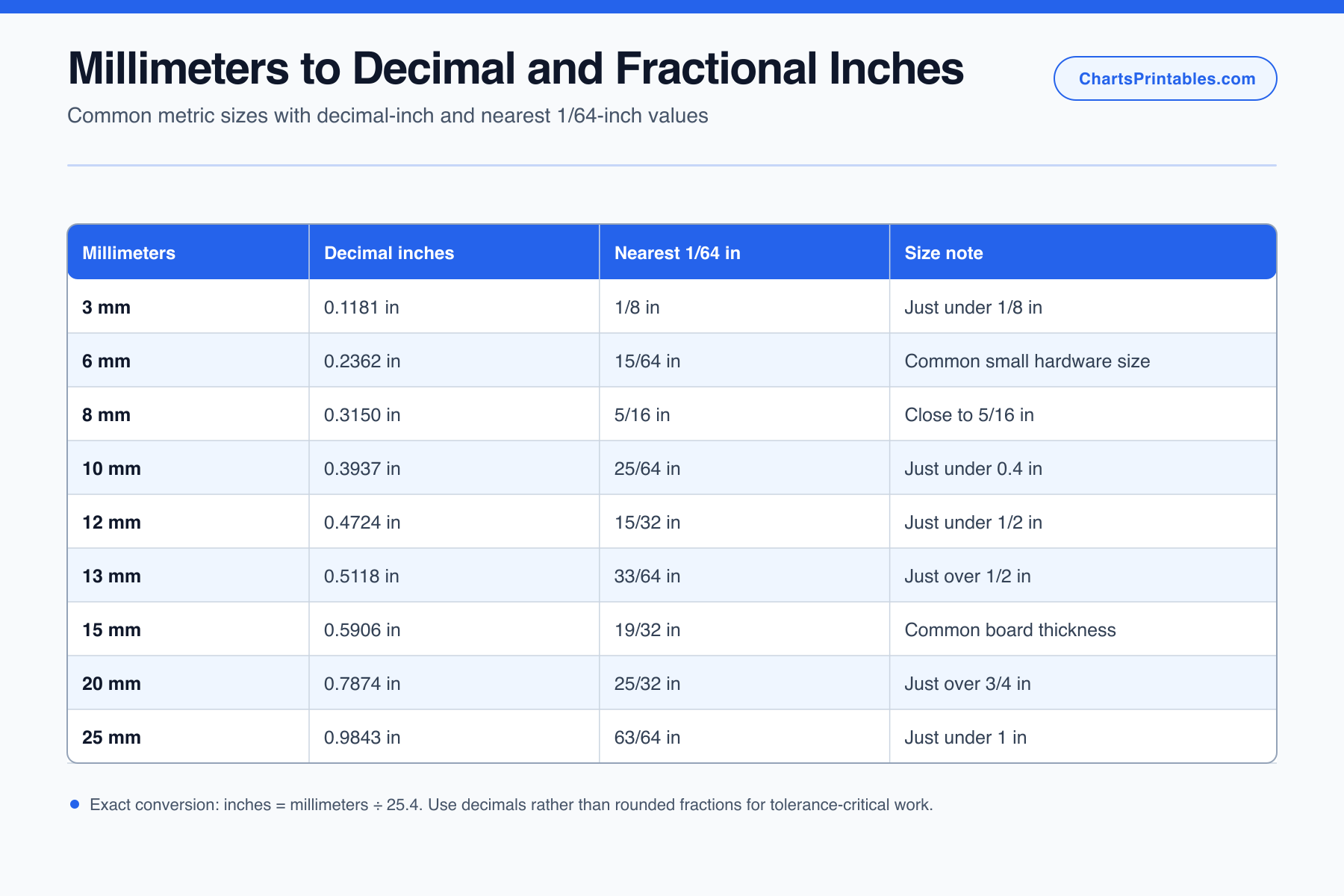
12 mm equals 0.4724 inches, or about 15/32 inch; 8 mm is about 5/16 inch and 25 mm is just under 1 inch.
Use the decimal-inch column when precision matters and the nearest 1/64-inch column for tape-measure and workshop reference. Every value is calculated with exactly 25.4 millimeters per inch.
Converted 10mm to 0.3937" but can't find it on your ruler? Here is how to bridge the gap.
Most US tape measures use 1/16" increments. For precision conversions, you need to find the nearest fraction:
If you are working in a shop and need a quick match for 10mm, it is almost exactly 25/64". However, most people use 3/8"as a "close enough" substitute for non-critical work, though it is slightly smaller than 10mm.
Trying to match a metric bolt to an imperial wrench? Use these common equivalents.
Never use an SAE wrench on a Metric bolt for high-torque applications (like engine work). The small difference (even 0.1mm) can cause the wrench to slip and round off the bolt head permanently.
| Dowel | Closest Bit | Fit |
|---|---|---|
| 5mm | 3/16" (4.76mm) | Too Tight |
| 6mm | 15/64" (5.95mm) | Snug/Perfect |
| 8mm | 5/16" (7.94mm) | Snug/Perfect |
| 10mm | 25/64" (9.92mm) | Very Snug |
Master millimeter to inches conversions with our comprehensive workshop guide.
Charts display up to 4 decimal places. For general fabrication, 3 places (0.XXX) is the industry standard.
Fractions are rounded to the nearest 1/64". Use these for marking workpieces with standard tape measures.
Always print at 100% scale. We recommend laminating these charts to protect them from workshop grime.
Standard for framing and decks. Conversions can be rounded to the nearest 1/16".
Furniture grade. Requires exact decimal-to-fraction matching for snug joinery.
Essential for metric-plans or imported router bits. Convert bit depth instantly.
Critical for tolerance stack-ups where metric and imperial parts must interface.
Match metric bolt heads to SAE sockets when the exact tool is missing.
Core Formula
Established in 1959, the international inch is exactly 25.4mm. For precision, always divide by 25.4.
Need the reverse direction? Use the Inches to MM chart when the source value starts in inches. If you need to turn a decimal inch result into a tape-measure fraction, use the Decimal to Fraction Inches chart or the Fraction to Decimal chart.
Need the reverse direction? Use the Inches to MM chart when the source value starts in inches. Working with drill bits or fasteners? Pair this chart with the Drill Bit Sizes chart and Wrench Size chart before choosing a shop reference.
| Decimal | Fraction | MM |
|---|---|---|
| 0.0156 | 1/64" | 0.40 |
| 0.0313 | 1/32" | 0.79 |
| 0.0625 | 1/16" | 1.59 |
| 0.1250 | 1/8" | 3.18 |
| 0.1875 | 3/16" | 4.76 |
| 0.2500 | 1/4" | 6.35 |
| 0.3125 | 5/16" | 7.94 |
| 0.3750 | 3/8" | 9.53 |
| 0.5000 | 1/2" | 12.70 |
| 0.6250 | 5/8" | 15.88 |
Convert inch decimals to common fractions for measuring, woodworking, and machining.
Customize & Download| Fraction | Decimal | Percent |
|---|---|---|
| 1/64 | 0.0156 | 1.56% |
| 1/32 | 0.0313 | 3.13% |
| 1/16 | 0.0625 | 6.25% |
| 1/8 | 0.1250 | 12.5% |
| 3/16 | 0.1875 | 18.8% |
| 1/4 | 0.2500 | 25% |
| 5/16 | 0.3125 | 31.3% |
| 3/8 | 0.3750 | 37.5% |
| 1/2 | 0.5000 | 50% |
| 3/4 | 0.7500 | 75% |
Fractions from 1/64 to whole numbers for math education and precision cutting.
Customize & Download| Inches (fraction) | Inches (decimal) | Millimeters | Centimeters |
|---|---|---|---|
| 1/4" | 0.250 | 6.35 | 0.64 |
| 1/2" | 0.500 | 12.70 | 1.27 |
| 1" | 1.000 | 25.40 | 2.54 |
| 1 1/2" | 1.500 | 38.10 | 3.81 |
| 2" | 2.000 | 50.80 | 5.08 |
| 2 1/2" | 2.500 | 63.50 | 6.35 |
| 3" | 3.000 | 76.20 | 7.62 |
| 4" | 4.000 | 101.60 | 10.16 |
| 5" | 5.000 | 127.00 | 12.70 |
| 6" | 6.000 | 152.40 | 15.24 |
| Number | Fraction | Decimal (in) | Millimeters |
|---|---|---|---|
| #80 | — | 0.0135 | 0.34 |
| #50 | — | 0.0700 | 1.78 |
| #52 | 1/16" | 0.0625 | 1.59 |
| #41 | 3/32" | 0.0938 | 2.38 |
| #22 | 5/32" | 0.1562 | 3.97 |
| #11 | 3/16" | 0.1875 | 4.76 |
| #7 | 13/64" | 0.2031 | 5.16 |
| — | — | 0.2570 | 6.53 |
| — | 3/8" | 0.3750 | 9.53 |
| — | 1/2" | 0.5000 | 12.70 |