1/8 increments keep a short chart for basic fraction and percentage practice. Each step equals 0.125 or 12.5 percentage points.
Fraction to Decimal ChartFractions, decimals, and percentages in one printable reference
Convert a fraction by dividing the numerator by the denominator. Then multiply the decimal by 100 to write it as a percentage. For example, 1/16 = 0.0625 = 6.25%, 3/8 = 0.375 = 37.5%, and 5/8 = 0.625 = 62.5%.
Use the chart to compare common fractions from halves and quarters through 1/64 increments. Choose the denominator, decimal places, percentage column, and inch-mark display that fit your reference task, then print the chart or use the available export options.
Fraction → Decimal → Percentage
Choose 1/8, 1/16, 1/32, or 1/64 rows
PDF and PNG export options
Browser print
Quick common fraction conversions
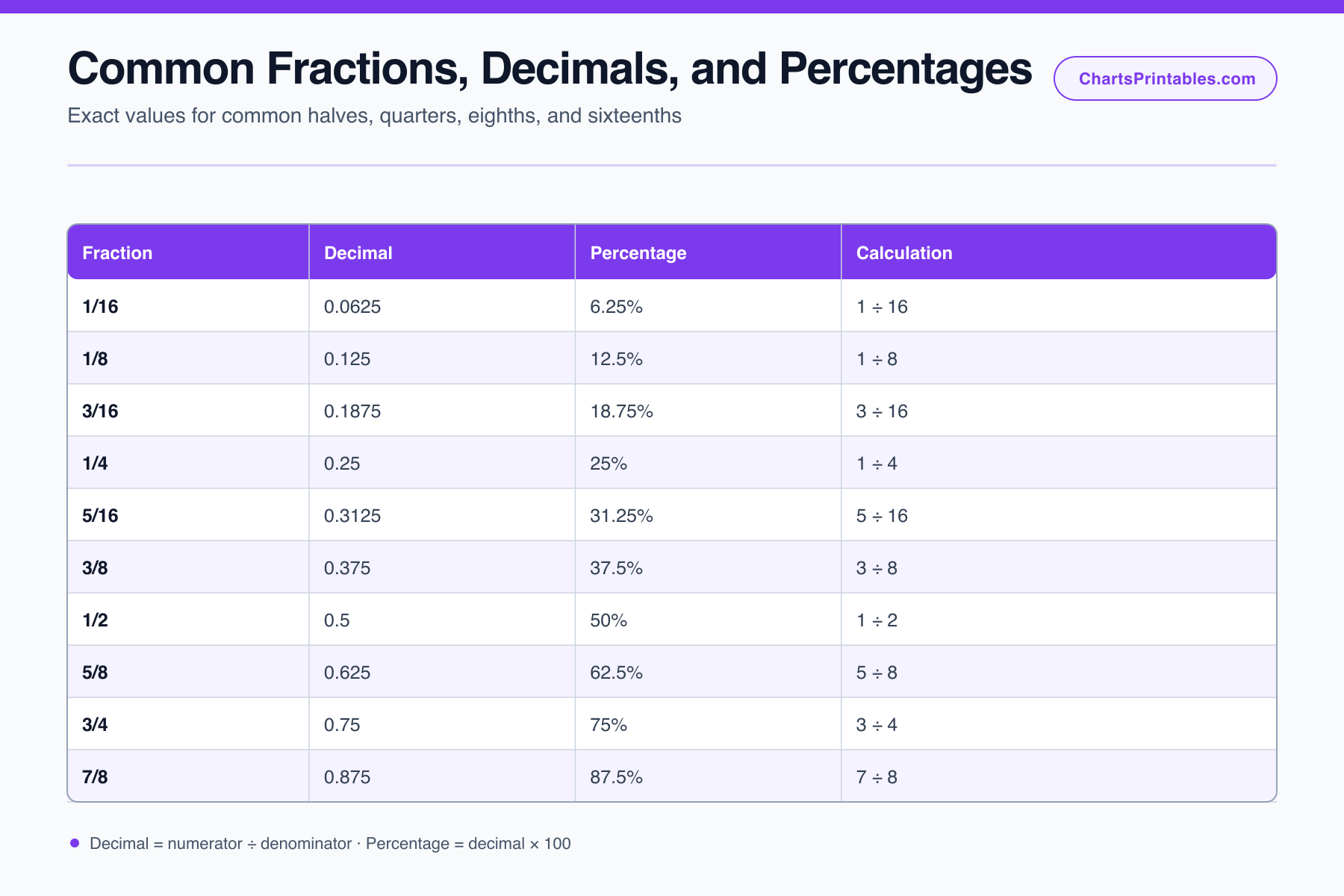
Start with these frequently used values. Fractions with denominators made only from factors of 2 and 5 have terminating decimal forms; other fractions may repeat and need a displayed rounding level.
| Fraction | Decimal | Percentage |
|---|---|---|
| 1/16 | 0.0625 | 6.25% |
| 1/8 | 0.125 | 12.5% |
| 3/16 | 0.1875 | 18.75% |
| 1/4 | 0.25 | 25% |
| 5/16 | 0.3125 | 31.25% |
| 3/8 | 0.375 | 37.5% |
| 1/2 | 0.5 | 50% |
| 5/8 | 0.625 | 62.5% |
| 3/4 | 0.75 | 75% |
| 7/8 | 0.875 | 87.5% |
These values are exact. A value such as 1/3 repeats: 1 ÷ 3 = 0.333... and about 33.333...%.
Visual quick reference
Common Fraction to Decimal Size Chart
For common sizes, 1/16 = 0.0625, 3/8 = 0.375, 5/8 = 0.625, and 7/8 = 0.875.
Divide the numerator by the denominator to get the decimal, then multiply by 100 for the percentage. These terminating values are useful for classroom work, ruler reading, woodworking, and general measurement lookup.
Build your fraction to decimal chart
Choose a maximum denominator and the number of decimal places. Turn percentages or inch marks on when they help your task. The preview below keeps the fraction, decimal, and optional percentage in the same row for quick lookup and printing.
3/3 free PDF/PNG downloads today
Quick Presets:
Preview & Download
Math Study • 1/16 • 4 decimals • 1 page • portrait
ChartsPrintables.com
Fraction to Decimal Conversion Chart
Precision: 1/16 • Decimal places: 4 • With percentages
💡Must Know Fractions
1/2
0.5
50%
1/4
0.25
25%
3/4
0.75
75%
1/8
0.125
12.5%
| Fraction | Decimal | Percentage |
|---|---|---|
| 1/16 | 0.0625 | 6.25% |
| 1/8 | 0.1250 | 12.50% |
| 3/16 | 0.1875 | 18.75% |
| 1/4 | 0.2500 | 25.00% |
| 5/16 | 0.3125 | 31.25% |
| 3/8 | 0.3750 | 37.50% |
| 7/16 | 0.4375 | 43.75% |
| 1/2 | 0.5000 | 50.00% |
| 9/16 | 0.5625 | 56.25% |
| 5/8 | 0.6250 | 62.50% |
| 11/16 | 0.6875 | 68.75% |
| 3/4 | 0.7500 | 75.00% |
| 13/16 | 0.8125 | 81.25% |
| 7/8 | 0.8750 | 87.50% |
| 15/16 | 0.9375 | 93.75% |
Formula: decimal = numerator ÷ denominator
Generated by ChartsPrintables.com • Free to use and share
File Details
Fractions
15
Precision
1/16 • 4 decimals
PDF FILE SIZE
≈0KB
Quality
300 DPI
Export Set
One setup, every version you need.
Classroom fraction pack
Printable fraction charts for class.
Seven complete references in Letter + A4, plus an index and classroom use notes.
How to convert a fraction to a decimal and percentage
Use the same calculation whether the fraction represents part of a whole, a classroom problem, or an inch measurement.
- 1
Divide the numerator by the denominator.
The numerator is the top number and the denominator is the bottom number. For 5/8, calculate 5 ÷ 8 = 0.625.
- 2
Multiply the decimal by 100 for a percentage.
Move the decimal point two places to the right: 0.625 × 100 = 62.5%.
- 3
Choose a sensible display precision.
Terminating decimals such as 3/8 = 0.375 can be shown exactly. Repeating decimals such as 2/3 = 0.666... must be rounded for display; 0.667 is 2/3 rounded to three decimal places.
- 4
Check the row and label the result.
Write 5/8 = 0.625 = 62.5%. If the fraction is an inch measurement, keep the inch unit with the measurement rather than treating the decimal as unitless.
Choose 1/8, 1/16, 1/32, or 1/64 increments
The denominator setting controls which fraction rows appear; it does not make a physical measurement more accurate. Choose the smallest increment you actually need and confirm tolerances with the measuring tool, drawing, or specification for the task.
1/16 increments match many classroom exercises and common tape-measure marks. One step equals 0.0625 or 6.25 percentage points.
1/32 increments give a finer workshop reference. One step equals 0.03125 or 3.125 percentage points.
1/64 increments provide a dense lookup table for small fractional-inch steps. One step equals 0.015625 or 1.5625 percentage points.
More rows provide finer lookup intervals, but they do not replace a tolerance, tool reading, or project specification.
Where a fraction to decimal chart helps
Education
Use the chart to connect three ways of writing the same value. A student can follow 3/8 across the row to 0.375 and 37.5%, compare it with 1/2, and see why 3/8 is smaller. Start with halves, quarters, and eighths, then add sixteenths as the class moves to finer partitions.
Measuring and workshop reference
Fractional-inch dimensions are common on tape measures, plans, and shop notes, while calculators, CAD fields, and digital tools often use decimal inches. The chart can translate a written value before data entry: 5/16 inch becomes 0.3125 inch, and 11/16 inch becomes 0.6875 inch. Treat the result as a conversion, not as a tolerance or fit decision. Check the drawing, tool, material, and required clearance when the measurement affects a cut, hole, or part.
Related fraction and measurement charts
Reverse the direction with the Decimal to Fraction Chart, or use Decimal to Fraction (Inches) when a decimal measurement needs a nearby fractional-inch reference. For an inch-focused fraction lookup, open Fraction to Decimal (Inches). Use the MM to Inches Chart when the starting measurement is metric rather than a fraction.
Decimal → FractionPrecision
| Dec | Frac | MM |
|---|---|---|
| 0.0156 | 1/64" | 0.397 |
| 0.0313 | 1/32" | 0.794 |
| 0.0625 | 1/16" | 1.588 |
| 0.1250 | 1/8" | 3.175 |
| 0.1875 | 3/16" | 4.763 |
| 0.2500 | 1/4" | 6.350 |
| 0.3750 | 3/8" | 9.525 |
| 0.5000 | 1/2" | 12.70 |
| 0.7500 | 3/4" | 19.05 |
| 1.0000 | 1" | 25.40 |
Decimal to Fraction Chart
Convert decimals into common fractions for measuring, drafting, and math.
View chartDecimal → InchesMachining
| Decimal | Fraction | MM |
|---|---|---|
| 0.0156 | 1/64" | 0.40 |
| 0.0313 | 1/32" | 0.79 |
| 0.0625 | 1/16" | 1.59 |
| 0.1250 | 1/8" | 3.18 |
| 0.1875 | 3/16" | 4.76 |
| 0.2500 | 1/4" | 6.35 |
| 0.3125 | 5/16" | 7.94 |
| 0.3750 | 3/8" | 9.53 |
| 0.5000 | 1/2" | 12.70 |
| 0.6250 | 5/8" | 15.88 |
Decimal to Fraction (Inches)
Convert inch decimals to common fractions for measuring, woodworking, and machining.
View chartInches → DecimalMachining
| Fraction | Decimal | MM |
|---|---|---|
| 1/64" | 0.0156 | 0.40 |
| 1/32" | 0.0313 | 0.79 |
| 1/16" | 0.0625 | 1.59 |
| 1/8" | 0.1250 | 3.18 |
| 3/16" | 0.1875 | 4.76 |
| 1/4" | 0.2500 | 6.35 |
| 5/16" | 0.3125 | 7.94 |
| 3/8" | 0.3750 | 9.53 |
| 1/2" | 0.5000 | 12.70 |
| 5/8" | 0.6250 | 15.88 |
Fraction to Decimal (Inches)
Convert inch fractions to decimals for woodworking, hardware sizing, and measuring.
View chartMM → InchesPro template
| Millimeters | Decimal (in) | Fraction (in) |
|---|---|---|
| 0.5 | 0.020 | 0 |
| 1 | 0.039 | 1/16 |
| 6.35 | 0.250 | 1/4 |
| 12.7 | 0.500 | 1/2 |
| 19 | 0.748 | 3/4 |
| 25.4 | 1.000 | 1 |
| 38.1 | 1.500 | 1 1/2 |
| 50.8 | 2.000 | 2 |
| 76.2 | 3.000 | 3 |
| 101.6 | 4.000 | 4 |
MM to Inches Chart
Convert millimeters to inches with decimals and fractions for woodworking and engineering.
View chartFrequently asked questions
What is 1/16 as a decimal and percentage?
Divide 1 by 16. The result is exactly 0.0625. Multiply by 100 to get 6.25%, so 1/16 = 0.0625 = 6.25%.
What is 3/8 as a decimal and percentage?
Three divided by eight is exactly 0.375. As a percentage, 0.375 × 100 = 37.5%, so 3/8 = 0.375 = 37.5%.
What is 5/8 as a decimal and percentage?
Five divided by eight is exactly 0.625. Multiply by 100 to get 62.5%, so 5/8 = 0.625 = 62.5%.
How do I convert any fraction to a decimal?
Divide the numerator, or top number, by the denominator, or bottom number. For example, 7/16 is 7 ÷ 16 = 0.4375. Reduce the fraction first if that makes the calculation easier; 4/8 and 1/2 both equal 0.5.
Why do some fractions have repeating decimals?
In lowest terms, a fraction has a terminating decimal only when the denominator's prime factors are 2, 5, or both. Fractions such as 1/3 and 2/3 repeat, so the chart must round them to the selected number of decimal places.
Which denominator should I choose for a printable chart?
Choose 1/8 for a short basic reference, 1/16 for common classroom or tape-measure work, 1/32 for finer workshop lookup, or 1/64 for a dense fractional-inch table. The setting controls chart intervals, not measurement tolerance.
How do I turn a decimal into a percentage?
Multiply the decimal by 100 and add the percent sign. For example, 0.25 becomes 25%, 0.375 becomes 37.5%, and 0.625 becomes 62.5%.