Drill Bit Size Chart for #36, #44, Number, Letter & Fractional Bits
Find the decimal and metric size for #30, #29, #36, #44, #11, fractional, letter, and wire gauge drill bits before drilling, tapping, or choosing a pilot hole. If you search for “size 44 drill bit” or “drill bit 44 size,” the standard #44 wire gauge drill is 0.0860 in, about 2.184 mm.
Direct answers
#30, #29, #36 and #44 Drill Bit Size Quick Answers
Use these values when you need the exact numbered drill diameter before tapping, checking a pilot hole, or comparing a metric substitute.
#30 drill bit size
A #30 drill bit is 0.1285 inches in diameter, about 3.264 mm. It is slightly larger than 1/8 in (0.1250 in), so do not treat 1/8 in as the same size when a drawing, tap chart, or clearance spec calls for #30.
Use the exact numbered bit when the hole size is tied to a tap, close clearance, or tolerance-sensitive layout.
#29 drill bit size
A #29 drill bit is 0.1360 inches in diameter, about 3.454 mm. It is commonly listed as an 8-32 UNC tap-drill size, but the correct choice still depends on thread form, material, and the tap chart you are using.
For tapping, check the tap chart or manufacturer data before drilling final holes.
#36 drill bit size
A #36 drill bit is 0.1065 inches in diameter, about 2.705 mm. A 2.7 mm bit is very close but slightly smaller, so it should not be treated as an exact equivalent when fit matters.
#36 is a common 6-32 UNC tap-drill reference; verify the tap chart, material, and required thread percentage.
#44 drill bit size
A #44 drill bit is 0.0860 inches in diameter, about 2.184 mm. The same answer applies to searches such as “size 44 drill bit” and “drill bit 44 size.”
A 2.2 mm bit is slightly larger; use #44 when pilot-hole precision or thread fit matters.
Visual quick reference
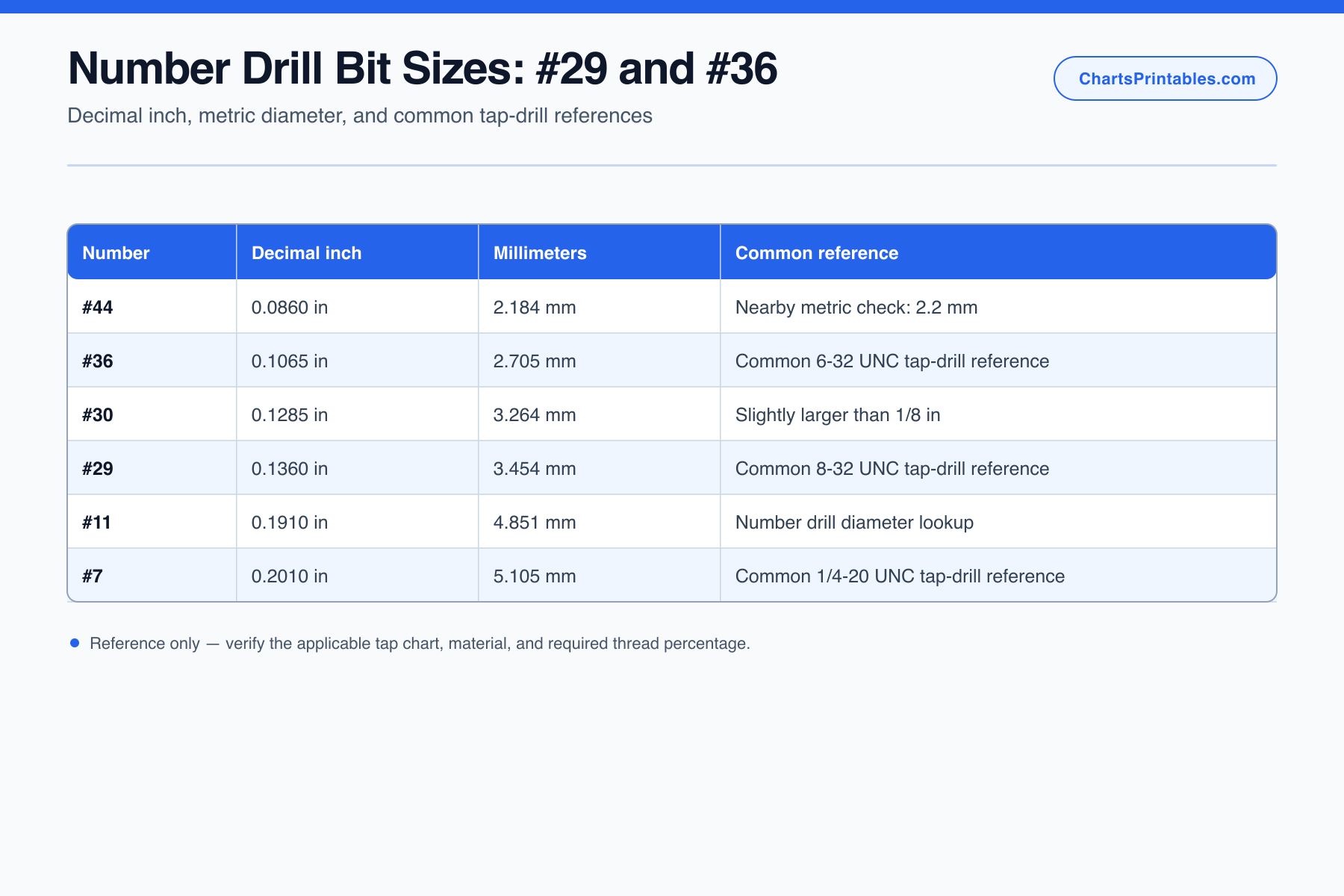
#29 and #36 Number Drill Bit Size Chart
#29 is 0.1360 in (3.454 mm), while #36 is 0.1065 in (2.705 mm).
The image compares the number sizes most often used for quick tap-drill and metric checks. A nearby metric diameter is not automatically an exact substitute, so confirm the thread, material, and controlling tap chart before drilling.
Number drill reference from #44 through #7, highlighting #36 and #29. Units are decimal inches and millimeters; use it for shop lookup and tap-drill checks, then verify the applicable tap chart.
Quick Answers for Common Drill Bit Sizes and Tap Drills
Use these quick answers when you need a drill diameter, a common tap-drill reference, or a nearby size comparison before you drill. For tapped holes, always confirm the tap chart, material, and required thread percentage before drilling final holes.
What you need
Size or common reference
Use this note
#44 drill bit
#44 = 0.0860 in / 2.184 mm
A 2.2 mm bit is nearby but slightly larger. Use an actual #44 bit when the hole size, fit, or thread preparation matters.
#30 drill bit compared with 1/8 in
#30 = 0.1285 in; 1/8 in = 0.1250 in
#30 is slightly larger than 1/8 in. Do not round down when a drawing, tap chart, clearance chart, or procedure calls for #30.
6-32 UNC tap drill
Common reference: #36 / 0.1065 in
Use this as a common starting reference, then confirm the tap chart, material, and required thread percentage.
8-32 UNC tap drill
Common reference: #29 / 0.1360 in
Verify the tap chart before final drilling, especially when material, thread fit, or thread percentage is important.
1/4-20 UNC tap drill
Common reference: #7 / 0.2010 in
#7 is a common 1/4-20 UNC tap-drill reference. Verify the chart, material, and thread percentage before drilling final holes.
Letter F drill bit
Letter F = 0.2570 in / 6.528 mm
Letter F is also a common 5/16-18 UNC tap-drill reference. Confirm the thread chart before tapping.
M6 x 1.0 tap drill
Common reference: 5.0 mm / 0.1969 in
Use the metric tap chart for the thread standard and material. Do not substitute a nearby numbered or fractional bit without checking the required fit.
Common number drill bit sizes
Use these common number drill sizes as lookup references, then compare the chart’s decimal inch and millimeter columns before choosing a nearby bit.
Number drill bit
Decimal inches
Metric diameter
Use note
#44 drill bit
0.0860 in
2.184 mm
Small numbered bit for precision pilot holes. A 2.2 mm bit is nearby but slightly larger, so use #44 when the exact hole size matters.
#36 drill bit size
0.1065 in
2.705 mm
Commonly checked for tap-drill and clearance lookups.
#30 drill size
0.1285 in
3.264 mm
Often compared with 1/8 in, but it is slightly larger.
#29 drill bit size
0.1360 in
3.454 mm
Commonly referenced in tap-drill lookups.
#25 drill bit
0.1495 in
3.797 mm
Common 10-24 UNC tap-drill reference. Confirm the tap chart, material, and required thread percentage before drilling final holes.
#21 drill bit
0.1590 in
4.039 mm
Numbered size near 5/32 in. Use #21 when the chart, drawing, or procedure calls for this exact diameter.
#11 drill bit size
0.1910 in
4.851 mm
Compare nearby fractional and metric sizes before substituting.
#7 drill bit
0.2010 in
5.105 mm
Common 1/4-20 UNC tap-drill reference. Verify the tap chart, material, and required thread percentage before tapping.
These values are lookup references, not universal instructions. Check the chart data, thread requirement, material context, and the source you are working from before final drilling.
Closest Common Drill Bit Substitutes
Use these nearby sizes as comparison checks only. A close metric or fractional bit may be acceptable for rough pilot holes, but use the specified size for tapping, close-clearance holes, drawings, or any fit that depends on the exact diameter.
Specified bit
Exact decimal
Exact metric
Nearby common size
Use the exact size when
#44
0.0860 in
2.184 mm
2.2 mm — slightly larger
The pilot hole size, thread fit, or drawing calls for #44.
#36
0.1065 in
2.705 mm
2.7 mm — very close, slightly smaller
You are tapping 6-32 threads, checking close clearance, or following a chart that specifies #36.
#30
0.1285 in
3.264 mm
1/8 in — close but smaller
A drawing, tap chart, clearance chart, or procedure specifies #30.
#29
0.1360 in
3.454 mm
3.5 mm — slightly larger
You are tapping 8-32 threads, checking close clearance, or following a chart that specifies #29.
#25
0.1495 in
3.797 mm
3.8 mm — very close, slightly larger
You are tapping 10-24 threads, checking close clearance, or following a chart that specifies #25.
#21
0.1590 in
4.039 mm
4.0 mm — slightly smaller
A chart, drawing, or procedure specifies #21.
#11
0.1910 in
4.851 mm
4.8 mm — slightly smaller
A chart, drawing, or procedure specifies #11.
#7
0.2010 in
5.105 mm
5.1 mm — very close, slightly smaller
You are tapping 1/4-20 threads or following a chart that specifies #7.
Choose the right lookup path
How to use these answers: first read the exact numbered drill size, then decide what job the hole is doing. A tap hole, a loose clearance hole, and a wood pilot hole can call for different choices even when the nearest fraction or metric size looks close.
If a drawing, tap chart, or manufacturer spec gives a numbered drill size, start with that exact numbered bit. For loose clearance or rough layout, a nearby fractional or metric bit may be acceptable, but check the spec before drilling final holes.
Tap drill
Start with the thread size, then read the recommended drill size. Do not round to the nearest fraction until you understand the thread requirement.
Pilot hole
Start with the screw material and pilot-hole purpose. A pilot hole is not the same decision as a tap-drill size.
Closest substitute
Use substitutes only as a reference check. Compare decimal inches and millimeters before choosing a nearby bit.
3/3 free PDF/PNG downloads today
Quick Presets:
Preview & Download
Workshop • 1/16 → 1/2 • A4 • 1 page • portrait
ChartsPrintables.com
Drill Bit Size Conversion Chart
Systems: Number, Fraction, Decimal, MM • Range 1/16 → 1/2 • A4
Number
Fraction
Decimal (in)
Millimeters
1/16"
0.0625
1.59
#52
0.0635
1.61
#51
0.0670
1.70
#50
0.0700
1.78
#49
0.0730
1.85
#48
0.0760
1.93
5/64"
0.0781
1.98
#47
0.0785
1.99
0.0787
2.00
#46
0.0810
2.06
#45
0.0820
2.08
#44
0.0860
2.18
#43
0.0890
2.26
#42
0.0935
2.38
3/32"
0.0938
2.38
#41
0.0960
2.44
#40
0.0980
2.49
0.0984
2.50
#39
0.0995
2.53
#38
0.1015
2.58
#37
0.1040
2.64
#36
0.1065
2.71
7/64"
0.1094
2.78
#35
0.1100
2.79
#34
0.1110
2.82
#33
0.1130
2.87
#32
0.1160
2.95
0.1181
3.00
#31
0.1200
3.05
1/8"
0.1250
3.17
#30
0.1285
3.26
#29
0.1360
3.45
0.1378
3.50
#28
0.1405
3.57
9/64"
0.1406
3.57
#27
0.1440
3.66
#26
0.1470
3.73
#25
0.1495
3.80
#24
0.1520
3.86
#23
0.1540
3.91
5/32"
0.1563
3.97
#22
0.1570
3.99
0.1575
4.00
#21
0.1590
4.04
#20
0.1610
4.09
#19
0.1660
4.22
#18
0.1695
4.30
11/64"
0.1719
4.37
#17
0.1730
4.39
#16
0.1770
4.50
0.1772
4.50
#15
0.1800
4.57
#14
0.1820
4.62
#13
0.1850
4.70
3/16"
0.1875
4.76
#12
0.1890
4.80
#11
0.1910
4.85
#10
0.1935
4.92
#9
0.1960
4.98
0.1969
5.00
#8
0.1990
5.05
#7
0.2010
5.11
13/64"
0.2031
5.16
#6
0.2040
5.18
#5
0.2055
5.22
#4
0.2090
5.31
#3
0.2130
5.41
0.2165
5.50
7/32"
0.2188
5.56
#2
0.2210
5.61
#1
0.2280
5.79
0.2340
5.94
15/64"
0.2344
5.95
0.2362
6.00
0.2380
6.04
0.2420
6.15
0.2460
6.25
1/4"
0.2500
6.35
0.2559
6.50
0.2570
6.53
0.2610
6.63
17/64"
0.2656
6.75
0.2660
6.76
0.2720
6.91
0.2756
7.00
0.2770
7.04
0.2810
7.14
9/32"
0.2813
7.14
0.2900
7.37
0.2950
7.49
0.2953
7.50
19/64"
0.2969
7.54
0.3020
7.67
5/16"
0.3125
7.94
0.3150
8.00
0.3160
8.03
0.3230
8.20
21/64"
0.3281
8.33
0.3320
8.43
0.3346
8.50
0.3390
8.61
11/32"
0.3438
8.73
0.3480
8.84
0.3543
9.00
0.3580
9.09
23/64"
0.3594
9.13
0.3680
9.35
0.3740
9.50
3/8"
0.3750
9.53
0.3770
9.58
0.3860
9.80
25/64"
0.3906
9.92
0.3937
10.00
0.3970
10.08
0.4040
10.26
13/32"
0.4063
10.32
0.4130
10.49
0.4134
10.50
27/64"
0.4219
10.72
0.4331
11.00
7/16"
0.4375
11.11
0.4528
11.50
29/64"
0.4531
11.51
15/32"
0.4688
11.91
0.4724
12.00
31/64"
0.4844
12.30
0.4921
12.50
1/2"
0.5000
12.70
Generated by ChartsPrintables.com • Free to use and share
File Details
Rows
128
Range
1/16 → 1/2 • A4
PDF FILE SIZE
≈0KB
Quality
300 DPI
Export Set
One setup, every version you need.
PRO
Fastener & Drill Pack
Keep the fastener and drill lookups you repeat at the bench.
Seven focused, watermark-free references plus an index for bolts, screws, drill bits, nails, wrenches, tap drills and fastener markings.
Drill bits in the US are categorized into three systems, each designed for specific manufacturing or construction precision:
Fractional Sizes: From 1/64" to 1" (and up). These are the "general-purpose" bits used in most home shops for wood and basic metal projects.
Wire Gauge (Number) Sizes: Designed for precision metalworking. Ranges from #1 (0.2280") down to #80 (0.0135"). These are essential for tapping machine threads accurately—using the wrong bit here often ruins the thread or breaks the tap.
Letter Sizes: Designed to bridge the gaps between fractional sizes, ranging from A (0.2340") to Z (0.4130"). Machinists use these for creating tight clearance holes for bolts.
Selecting the Right Bit for Your Project
General Construction: When working with wood or standard light metal, fractional bits provide the most common and accessible sizing increments.
Machining & Tapping: Numbered wire gauge bits support precise thread preparation. Always verify the tap-drill chart; for example, #36 is a common reference for 6-32 UNC threads.
Precision Clearances: When a bolt must pass through a controlled clearance hole, letter-sized bits provide intermediate diameters that fractional sets may not include.
Wood Screw Pilot Hole Guide
Prevent split wood and stripped screws. Match your drill bit to the screw size and wood hardness.
Screw Size
Softwood Pilot (Pine, Cedar)
Hardwood Pilot (Oak, Maple)
Clearance Hole (Shank pass-through)
#4
1/16"
5/64"
1/8"
#6
1/16"
5/64"
9/64"
#8
5/64"
3/32"
11/64"
#10
3/32"
7/64"
3/16"
#12
7/64"
1/8"
7/32"
#14
9/64"
11/64"
1/4"
Which Drill Bit Type?
Expert guidance on selecting bit geometry and materials for professional results.
Twist Bit
Wood, Metal, Plastic
General purpose bits. Standard 118° is for soft materials; 135° split-point is for harder metals.
Brad Point
Wood Only
Precision center point prevents wandering. Ideal for clean holes in cabinetry.
Masonry Bit
Brick, Concrete
Carbide-tipped for masonry. Usually paired with a hammer drill for masonry work.
Cobalt (M35/M42)
Hard Metals
Resistant to high heat. Often used for stainless steel and professional machining.
Professional Drilling Tips
How to use this chart to improve your accuracy in the workshop.
Measure Diameter
If markings are worn, use a digital caliper to measure the drill shank. Cross-reference this with our Decimal column.
Prevent Bit Walking
In metal, use a Center Punch to create a dimple. In wood, use a Brad Point bit to ensure the hole starts exactly where intended.
Calculate Clearance
Use the specified clearance hole for the screw shank when the joint design calls for the threads to engage only the second piece. Confirm the fastener chart and material before drilling.
Common Uses for Specific Drill Bit Sizes
Selecting the right drill bit is essential for a clean and secure hole.
General Construction (Fractional)
Common sizes like 1/8", 1/4", and 3/8" are standard for drilling into wood, drywall, and plastic.
Threading and Tapping (Number/Wire Gauge)
Numbered drill bits provide the intermediate diameters used by many tap charts. A #36 bit is a common 6-32 UNC reference, but the correct drill can vary with the material and required thread percentage. Compare the recommendation with our Bolt & Screw Sizes Chart and verify the tap manufacturer's data before drilling.
Clearance Holes (Letter)
When a bolt needs to pass through material without threading into it, letter-sized bits offer intermediate clearance diameters that fractional sets may omit. For general wood screws, compare the fastener and material with our Screw Size Reference. To compare fractional measurements, use our Fraction to Decimal Chart.
Tap Drill Selection Guide
Match the drill diameter to the thread standard, material, and target thread percentage before tapping.
For machine screws, the drill bit is not just a clearance hole. It controls thread engagement. For example, a #36 drill bit is the common tap drill for 6-32 UNC, #29 is common for 8-32 UNC, and #7 is common for 1/4-20 UNC. Always verify material and thread percentage before tapping metal.
Thread Size
Threads / Inch
Tap Drill
Decimal (in)
6-32 UNC
32
#36
0.1065"
8-32 UNC
32
#29
0.1360"
10-24 UNC
24
#25
0.1495"
1/4"-20 UNC
20
#7
0.2010"
5/16"-18 UNC
18
Letter F
0.2570"
M6 x 1.0
1.0mm
5.0mm
0.1969"
Related workshop charts for drilling and fasteners
After checking a drill size, the next reference is often the fastener, the wrench, or the decimal equivalent. Use Screw Size for screw diameter context, Bolt Size for thread and wrench checks, and Fraction to Decimal when a drawing uses fractional inches.
A #30 drill bit is 0.1285 inches in diameter, about 3.264 mm. It is close to 1/8 in but slightly larger, so use a #30 bit when a tap chart, clearance chart, drawing, or procedure calls for #30.
What size is a #29 drill bit?
A #29 drill bit is 0.1360 inches in diameter, about 3.454 mm. It is commonly listed as an 8-32 UNC tap-drill size, but the correct drill depends on thread standard, material, and the tap chart you are following.
What size is a #36 drill bit?
A #36 drill bit is 0.1065 inches, or about 2.705 mm. A 2.7 mm bit is very close but slightly smaller. #36 is commonly listed as a 6-32 UNC tap-drill reference; confirm the tap chart, material, and required thread percentage before drilling.
What size is a #44 drill bit?
A #44 drill bit is 0.0860 inches in diameter, about 2.184 mm. The same size is often searched as “size 44 drill bit” or “drill bit 44 size.” A nearby 2.2 mm bit is slightly larger, not an exact substitute.
What is the closest substitute for a #36 drill bit?
A 2.7 mm bit is very close to a #36 drill bit, but use an actual #36 bit when tapping 6-32 threads or when the fit matters.
What is the closest substitute for a #44 drill bit?
A 2.2 mm bit is the closest common metric check for a #44 drill bit, but it is slightly larger. Use #44 when thread fit or pilot-hole precision matters.
What size is a #11 drill bit?
A #11 drill bit is 0.1910 inches, or about 4.851 mm.
What size is a #21 drill bit?
A #21 drill bit is 0.1590 inches in diameter, which converts to 4.039 mm.
What is the actual diameter of a #1 wire gauge drill bit?
A #1 wire gauge drill bit has a decimal diameter of 0.2280 inches. In the number system, #1 is the largest, and #80 is the smallest (0.0135 inches).
What is the equivalent of a Letter F drill bit?
A Letter F drill bit has a decimal diameter of 0.2570 inches. It is most commonly used as the tap drill for a 5/16"-18 UNC thread.
What is the difference between 118° and 135° drill bits?
118-degree bits are general-purpose and ideal for wood and soft metals. 135-degree split-point bits are designed for harder metals like stainless steel because they bite into the material and do not walk across the surface.
Which drill bit should I use for a 1/4"-20 tap?
The standard tap drill for a 1/4"-20 UNC thread is a #7 drill bit (0.2010 inches). This ensures approximately 75% thread engagement.
How do I convert millimeters to drill bit sizes?
Use the chart to compare the metric measurement with the nearest number, letter, or fractional drill bit. For example, a 6 mm bit is slightly smaller than a 1/4 inch (6.35 mm) bit.
What is a wire gauge drill bit?
Wire gauge sizes are a numbered system from #1 to #80 typically used for small-diameter precision drilling in machining, tapping, electronics, and model work.
How do I choose between fractional and wire drill bits?
Choose fractional bits for general carpentry or clearance holes where loose tolerance is acceptable. Choose wire gauge bits for precision tasks like tapping metal, where exact diameter is required to ensure thread strength.
What is the smallest wire gauge drill bit?
The #80 drill bit is the smallest in the wire gauge system, measuring 0.0135 inches (0.343 mm).