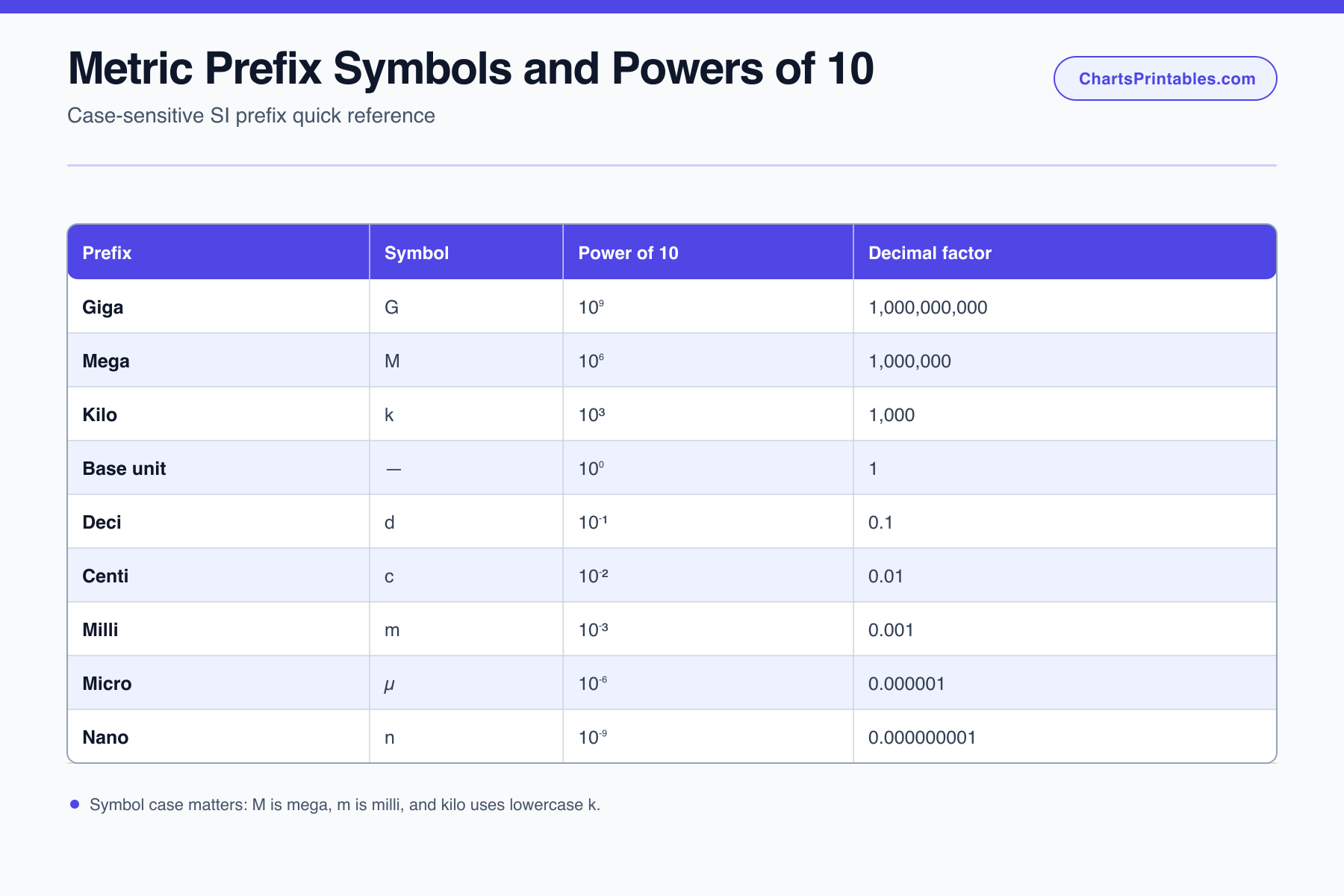
Metric Prefixes Chart(SI Units & Powers of 10)

Instantly convert between SI prefixes from Yotta to Yocto. Visualize the scale of the universe from atomic particles to galaxies with this comprehensive, printable metric system guide.

SI StandardYotta to Yocto
PDF ExportPrint-ready charts
ScientificPowers of 10
3/3 free downloads today
Quick Presets:

Preview & Download

Standard Range Yotta → Yocto

ChartsPrintables.com

Metric Prefixes Chart

Range: Yotta to Yocto • SI Units & Powers of 10

PrefixSymbolPower of 10Decimal Value
YottaY10²⁴1,000,000,000,000,000,000,000,000
ZettaZ10²¹1,000,000,000,000,000,000,000
ExaE10¹⁸1,000,000,000,000,000,000
PetaP10¹⁵1,000,000,000,000,000
TeraT10¹²1,000,000,000,000
GigaG10⁹1,000,000,000
MegaM10⁶1,000,000
Kilok10³1,000
Hectoh10²100
Decada10¹10
(Base)-10⁰1
Decid10⁻¹0.1
Centic10⁻²0.01
Millim10⁻³0.001
Microµ10⁻⁶0.000001
Nanon10⁻⁹0.000000001
Picop10⁻¹²0.000000000001
Femtof10⁻¹⁵0.000000000000001
Attoa10⁻¹⁸0.000000000000000001
Zeptoz10⁻²¹0.000000000000000000001
Yoctoy10⁻²⁴0.000000000000000000000001

Generated by ChartsPrintables.com • Free to use and share

File Details

Entries

21

Range

Yotta → Yocto

PDF Spec

0KB

Print Quality

300 DPI

How to Use This Metric Chart

Master unit conversions in three simple steps using our comprehensive reference table.

Identify the Prefix

Locate the prefix symbol (like 'k' or 'µ') attached to your unit (km, µg) in the chart.

Find the Factor

Read across to see the multiplication factor. 'k' means 10³ or 1,000 times the base unit.

Move the Decimal

Use the power of 10 to shift your decimal point. Positive powers move it right; negative powers move it left.

Common Applications

From the laboratory to the server room, metric prefixes are universal.

🔬

Science & Lab

Essential for chemistry concentrations (molar to nanomolar), biological cell sizes (micrometers), and physics calculations.

  • Molar to Nanomolar conversions
  • Cell sizes in Micrometers
  • Atomic scale in Angstroms/Picometers
💻

Computing & Tech

Understand data storage (Terabytes, Petabytes) and processor speeds (Gigahertz). Note: Binary prefixes (KiB, MiB) differ slightly.

  • Storage capacity (TB, PB)
  • Frequency (GHz, MHz)
  • Network speeds (Gbps)
🏗️

Engineering

Precise conversion for electronics (microfarads, megaohms) and structural loads (kilonewtons, gigapascals).

  • Capacitance (µF, pF)
  • Resistance (kΩ, MΩ)
  • Pressure & Stress (kPa, GPa)

Metric System Fundamentals

Key concepts to help you understand and use the International System of Units (SI) effectively.

Basics

Base Units vs. Prefixes

The base unit (meter, gram, second) has no prefix and a factor of 10⁰ (1). Prefixes modify this base to handle larger or smaller quantities.

Math

Scientific Notation

A method to write very large or very small numbers. 1,000,000 becomes 1 × 10⁶. This simplifies calculations and improves readability.

Scale

Large vs. Small Scales

Positive powers (k, M, G) represent multiples (large scale). Negative powers (m, µ, n) represent fractions (small scale).

Syntax

Capitalization Rules

Case matters! 'M' is Mega (10⁶), 'm' is Milli (10⁻³). 'P' is Peta, 'p' is pico. Always check the symbol case carefully.

Frequently Asked Questions

Straight answers for common questions about metric prefixes.

What is the difference between Milli and Micro?
Milli (m) is 10⁻³ (one thousandth), while Micro (µ) is 10⁻⁶ (one millionth). A micro unit is 1,000 times smaller than a milli unit.
Are capitalization rules important?
Yes! 'M' is Mega (10⁶), while 'm' is Milli (10⁻³). 'P' is Peta, 'p' is pico. Always check the case to avoid errors of magnitude.
What is the base unit?
The base unit has no prefix and a factor of 10⁰ (1). Examples include meter (length), gram (mass), liter (volume), and second (time).
What are the largest and smallest prefixes?
Currently, the standard SI prefixes range from Quetta (10³⁰) down to Quecto (10⁻³⁰). This chart covers the common range from Yotta (10²⁴) to Yocto (10⁻²⁴).
How do I export or print this chart?
Use the 'Download PDF' button for a high-quality, printable file. You can also download a PNG image or print directly from your browser. The 'Print Chart' option opens your system's print dialog.
Why are some prefixes skipped?
Prefixes generally follow steps of 1000 (10³). Between 10³ and 10⁻³, there are steps of 10 (Hecto, Deca, Deci, Centi), but outside this range, they jump by powers of 3.