ML (Milliliters) to Cups Conversion Chart
Perfect for following international recipes! Convert milliliters to US Cups, Metric Cups, or Imperial Cups instantly. Browser print is free, plus one PDF or PNG download daily without signup.
Direct answers
How many cups are in 250 ml, 500 ml, and 1 liter?
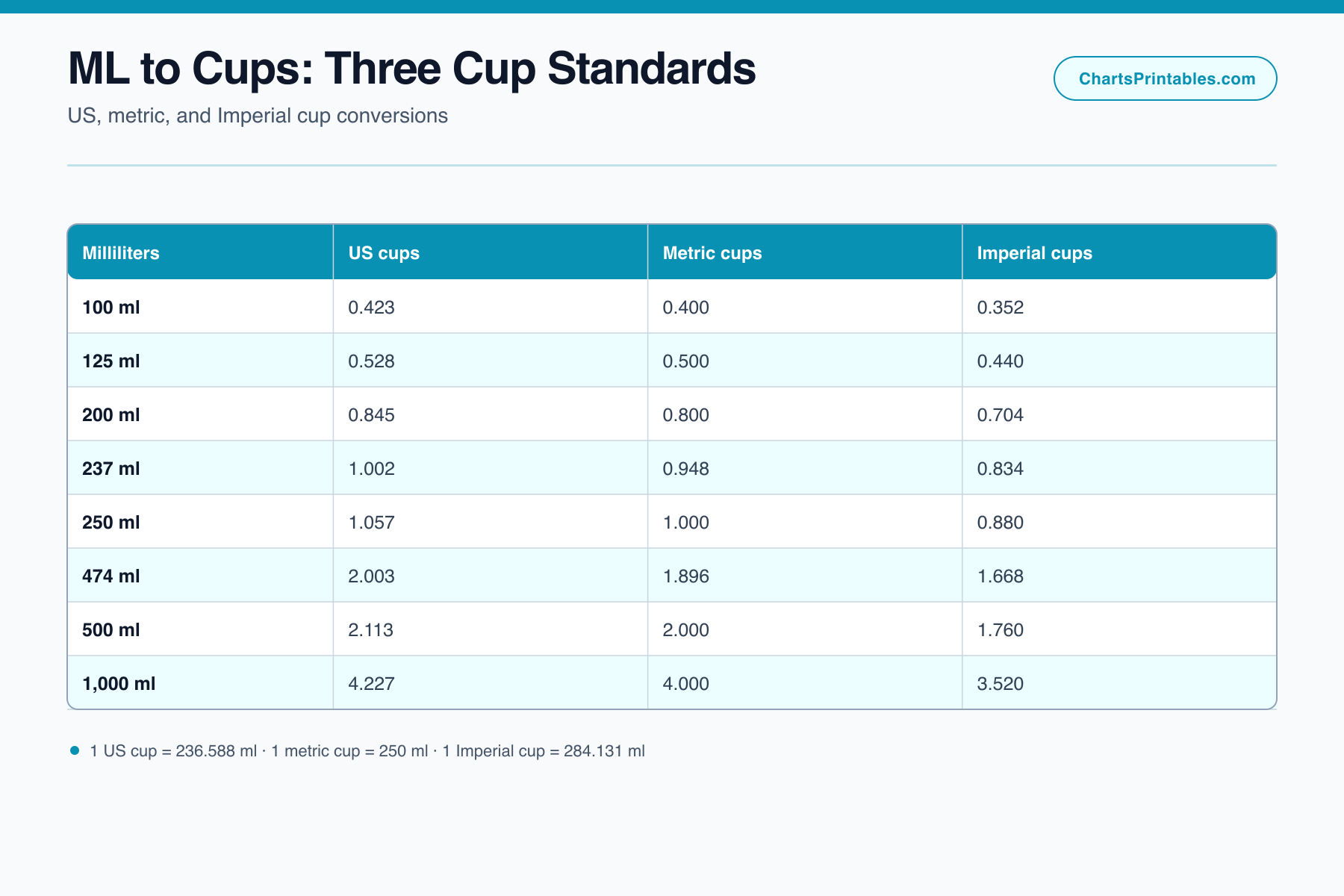
In US customary cups, 250 ml is about 1.057 cups, 500 ml is about 2.113 cups, and 1 liter is about 4.227 cups. A metric cup is exactly 250 ml, so those same amounts equal 1, 2, and 4 metric cups. Cup standards differ, so identify the recipe's cup system before converting.
| Milliliters | US cups (236.588 ml) | Metric cups (250 ml) | Imperial cups (284.131 ml) |
|---|---|---|---|
| 100 ml | 0.423 | 0.4 | 0.352 |
| 125 ml | 0.528 | 0.5 | 0.44 |
| 200 ml | 0.845 | 0.8 | 0.704 |
| 237 ml | 1.002 | 0.948 | 0.834 |
| 250 ml | 1.057 | 1 | 0.88 |
| 474 ml | 2.003 | 1.896 | 1.668 |
| 500 ml | 2.113 | 2 | 1.76 |
| 1000 ml | 4.227 | 4 | 3.52 |
Need the reverse direction? Use the Cups to ML Chart for cup-first values such as 1/3 cup, 2/3 cup, and 2 cups.
Visual quick reference
ML to Cups Across US, Metric, and Imperial Standards
250 ml equals about 1.057 US cups, exactly 1 metric cup, or about 0.880 Imperial cup.
Cup size is not universal. Use the column that matches the recipe or measuring set: 236.588 ml for a US cup, 250 ml for a metric cup, or 284.131 ml for an Imperial cup.
Preview & Download
Baking • 50-500ml • 1 page • portrait
ChartsPrintables.com
ML to Cups Conversion Chart (US)
1 US cup = 236.588ml • 50-500ml
| Milliliters (ml) | Cups | Tbsp | Tsp | fl oz |
|---|---|---|---|---|
| 50 | 0.211 | 3.4 | 10.1 | 1.7 |
| 100 | 0.423 | 6.8 | 20.3 | 3.4 |
| 150 | 0.634 | 10.1 | 30.4 | 5.1 |
| 200 | 0.845 | 13.5 | 40.6 | 6.8 |
| 250 | 1 0.057 | 16.9 | 50.7 | 8.5 |
| 300 | 1 0.268 | 20.3 | 60.9 | 10.1 |
| 350 | 1 0.479 | 23.7 | 71.0 | 11.8 |
| 400 | 1 0.691 | 27.1 | 81.2 | 13.5 |
| 450 | 1 0.902 | 30.4 | 91.3 | 15.2 |
| 500 | 2 0.113 | 33.8 | 101.4 | 16.9 |
1 US cup = 236.588ml
Generated by ChartsPrintables.com • Free to use and share
Rows
10
Range
50-500ml
PDF FILE SIZE
≈0KB
Quality
300 DPI
Export Set
One setup, every version you need.
Understanding ML to Cups Conversion
Learn why milliliter measurements vary across different cup systems
US Cups
237 ml
(236.588 ml exact)
The standard cup measurement in American recipes. Most US-based cookbooks and online recipes use this measurement.
Common in:
- United States
- Most English-language recipes
- American food blogs
💡 1 US cup = 16 tablespoons = 8 fluid ounces
Metric Cups
250 ml
(exact)
Used in metric system countries. The measurement is exactly 250 milliliters - no decimal conversion needed!
Common in:
- Australia & New Zealand
- Some Asian countries
- International metric recipes
💡 4 metric cups = 1 liter exactly
Imperial Cups
284 ml
(10 fl oz)
Historically used in the UK and Canada. Less common today but still found in older recipes.
Found in:
- Older UK/Canadian cookbooks
- Traditional British recipes
- Heritage cooking
⚠️ 47ml larger than US cups - significant!
Important: Choose the Correct Cup System!
When converting milliliters to cups, always check which cup system your measuring tools use. The 13-47ml difference can significantly affect recipe outcomes, especially in baking.
Quick Guide:
- • Following a US recipe? Convert to US cups (237ml)
- • Australian recipe? Use Metric cups (250ml)
- • Vintage British recipe? May need Imperial cups (284ml)
- • Unsure? Check recipe source or use metric weight instead
How to Use This Chart
Simple steps to convert milliliters to cups accurately
1. Identify ML Amount
- •Check your liquid measuring container
- •Read the milliliter marking at eye level
- •Or check your recipe requirements
Example:
Recipe calls for 500ml of milk? Look up 500ml in the chart.
2. Find Cup Equivalent
- •Locate your ML value in the chart
- •Read the corresponding cup measurement
- •Check which cup system (US/Metric/Imperial)
Example:
500ml = 2.1 US cups (237ml each)
500ml = 2.0 Metric cups (250ml each)
3. Measure Accurately
- Use the correct measuring cup type
- Place cup on flat surface
- Pour liquid and check at eye level
💡 Pro Tip:
For best accuracy, use a liquid measuring cup (clear with spout) for liquids, not dry measuring cups!
Common ML to Cups Conversions
Small Volumes (Under 100ml)
| ML | US Cups | Metric Cups | Tablespoons |
|---|---|---|---|
| 15 ml | 1/16 cup | 1/16 cup | 1 Tbsp |
| 30 ml | 1/8 cup | 1/8 cup | 2 Tbsp |
| 60 ml | 1/4 cup | 1/4 cup | 4 Tbsp |
Standard Measurements (100ml - 1L)
| ML | US Cups | Metric Cups | Common Use |
|---|---|---|---|
| 125 ml | 1/2 cup | 1/2 cup | Small serving |
| 250 ml | 1 cup | 1 cup (exact!) | Standard cup |
| 500 ml | 2.1 cups | 2 cups (exact!) | Common recipe amount |
| 1000 ml (1L) | 4.2 cups | 4 cups (exact!) | 1 liter |
Large Batch Cooking (Over 1L)
| ML | US Cups | Metric Cups | Common Use |
|---|---|---|---|
| 2000 ml (2L) | 8.5 cups | 8 cups | Large batch soup |
| 5000 ml (5L) | 21 cups | 20 cups | Party punch |
The "Rice Cooker Cup" Trap
Rice Cooker Cups are smaller! A standard "Gō" cup for rice cookers is 180ml (approx 3/4 US Cup). Do not use a standard 240ml measuring cup with the water lines in your pot, or your rice will be mushy!
Rule of Thumb: Always use the plastic cup that came with your rice cooker. If you lost it, use 180ml of rice per line of water.
Common Grocery Containers
| Item | Metric Volume | Approx Cups |
|---|---|---|
| Small Heavy Cream | 236 ml | 1 Cup |
| Sour Cream / Cottage Cheese | 500 ml | 2 Cups |
| Yogurt (Large Tub) | 750 ml | ~3 Cups |
| Broth / Stock Carton | 946 ml | 4 Cups |
Daily Water Intake Guide
Tracking your hydration? Here's the math.
250 ml
1 Cup
500 ml
2 Cups
1 Liter
~4.2 Cups
2 Liters
~8.5 Cups
Based on standard US cups (237ml) approx.
When to Use ML vs Cups
✅Use Milliliters (ML) When:
International Recipes
Most European, Asian, and Australian recipes use metric measurements (ml, grams) for consistency.
Precision Matters
For baking, cocktails, or scientific cooking where exact measurements are critical for success.
Small Quantities
Measuring small amounts like 15ml or 30ml is more accurate than trying to measure fractions of cups.
You Have ML Containers
If your bottles, packages, or measuring tools already show milliliters, stick with that system.
🥤Use Cups When:
American Recipes
US cookbooks and food blogs typically use cup measurements. Easier to follow recipes in their original format.
Quick Cooking
For everyday cooking where exact precision isn't critical, cups are fast and convenient.
You Have Cup Measures
If your kitchen is equipped with US measuring cups, use them - they're perfectly accurate for most cooking.
Dry Ingredients
Dry measuring cups work well for flour, sugar, rice, and other dry goods (though weight is most accurate).
💡Best Practice: Match Recipe Format
The golden rule: Use the same measurement system as your recipe source. If a recipe is in milliliters, use ml. If it's in cups, use cups. Converting between systems can introduce small errors that compound in complex recipes.
When You MUST Convert:
- • Use this chart for accurate conversions
- • Check the cup type (US/Metric/Imperial) in recipe
- • Round sensibly - 237ml ≈ 1 US cup is fine for most cooking
- • For baking - consider using weight (grams) instead for best results
Related Kitchen Conversions
Complete your kitchen conversion toolkit
| Cups | Milliliters | Tbsp | Tsp | fl oz |
|---|---|---|---|---|
| 1/4 | 59 | 4 | 12 | 2 |
| 1/3 | 78 | 5.3 | 15.8 | 2.6 |
| 1/2 | 118 | 8 | 24 | 4 |
| 177 | 12 | 36 | 6 | |
| 1 | 237 | 16 | 48 | 8 |
| 355 | 24 | 72 | 12 | |
| 2 | 473 | 32 | 96 | 16 |
| 3 | 710 | 48 | 144 | 24 |
| 4 | 946 | 64 | 192 | 32 |
| 6 | 1420 | 96 | 288 | 48 |
Cups to ML Chart
Kitchen measurement conversions for international recipes, baking, and coffee ratios.
| Grams (g) | Ounces (oz) |
|---|---|
| 25 | 0.88 |
| 50 | 1.76 |
| 75 | 2.65 |
| 100 | 3.53 |
| 150 | 5.29 |
| 200 | 7.05 |
| 250 | 8.82 |
| 300 | 10.58 |
| 500 | 17.64 |
| 1000 | 35.27 |
Grams to Ounces
Weight conversion chart for kitchen recipes and ingredient prep.
| Tablespoons | Milliliters | Tsp | Cups | fl oz |
|---|---|---|---|---|
| 1/4 | 4 | 0.8 | 0.02 | 0.1 |
| 1/2 | 7 | 1.5 | 0.03 | 0.3 |
| 3/4 | 11 | 2.3 | 0.05 | 0.4 |
| 1 | 15 | 3 | 0.06 | 0.5 |
| 1.50 | 22 | 4.5 | 0.09 | 0.8 |
| 2 | 30 | 6 | 0.13 | 1.0 |
| 4 | 59 | 12 | 0.25 | 2.0 |
| 6 | 89 | 18 | 0.38 | 3.0 |
| 8 | 118 | 24 | 0.50 | 4.0 |
| 12 | 177 | 36 | 0.75 | 6.0 |
Tablespoons to ML
Convert tablespoons to milliliters with quick teaspoon cross-references for recipes.
| °F | °C | Gas Mark | Use |
|---|---|---|---|
| 175 | 79 | - | Warm |
| 200 | 93 | - | Low roast |
| 225 | 107 | ¼ | Low & slow |
| 250 | 121 | ½ | Slow roast |
| 275 | 135 | 1 | Gentle bake |
| 300 | 149 | 2 | Baking |
| 325 | 163 | 3 | Roast light |
| 350 | 177 | 4 | Roast |
| 375 | 191 | 5 | Golden |
| 400 | 204 | 6 | Crisp finish |
Fahrenheit to Celsius
Temperature conversion chart with oven presets for cooking, travel, and weather.
Explore more: All Charts · Categories · Use Cases
Frequently Asked Questions
How many ml in a cup?
It depends on which cup system: 1 US cup = 237ml (236.588ml exact), 1 Metric cup = 250ml (exact), 1 Imperial cup = 284ml. Most American recipes use US cups (237ml).
How do I convert 500ml to cups?
For 500ml: US cups: 500ml ÷ 237ml = 2.1 cups, Metric cups: 500ml ÷ 250ml = 2.0 cups (exactly!), Imperial cups: 500ml ÷ 284ml = 1.76 cups. Use this chart to look up any ml value instantly!
Which cup system should I use for international recipes?
It depends on the recipe's origin: US/American recipes → Use US cups (237ml), Australian/NZ recipes → Use Metric cups (250ml), European recipes → Usually in ml/grams (use Metric cups if converting), UK recipes → Modern ones use metric; older ones may use Imperial cups. Pro tip: When in doubt, use the metric system (ml/grams) for international recipes - it's more universal and precise!
Can I use a regular cup instead of a measuring cup?
Not recommended! Regular drinking cups vary widely in size (200-350ml). For accurate cooking, use proper measuring cups: Liquid measuring cups (clear with spout and measurement lines), Dry measuring cups (flat rim for leveling off), or a Digital scale (best for precision, measures in ml/grams). Accurate measurements = better cooking results!
Is 250ml exactly 1 cup?
Yes, BUT only for Metric cups! Metric cup: 250ml = 1 cup (exactly) ✓, US cup: 250ml = 1.05 cups (slightly more than 1 cup), Imperial cup: 250ml = 0.88 cups (slightly less than 1 cup). This is why it's important to know which cup system your recipe uses!
Should I round ML to cups conversions?
For everyday cooking: Yes, rounding is fine! (500ml ≈ 2 cups works for most recipes). For precision baking: Use exact measurements or a kitchen scale. Cakes, pastries, and bread need precision as small differences can affect texture and rise. Consider measuring by weight (grams) instead. Bottom line: For soups, stews, drinks → round away! For baking → be precise!
Still have questions about ML to Cups conversions?
We're here to help! Email us with your questions or feedback.
Email: support@chartsprintables.com