What is 4x4 actual size?
A nominal 4x4 post is usually 3.5" × 3.5" actual.
Use this actual width for post caps, brackets, holes, and spacing.
Find the actual size behind common lumber labels before you cut. A 4x4 post is usually 3.5" × 3.5" actual, a 1x6 board is usually 3/4" × 5-1/2", and wood trim sizes vary by profile and manufacturer. Use the printable nominal vs actual lumber size chart for planning, then measure the board or trim piece you will use before final cuts.
Quick answer
Nominal lumber names are the store labels. Actual dimensions are the measurements you should use for layout, cutting, joinery, and hardware. Start with the quick answers below, then use the full printable chart for longer size ranges.
A nominal 4x4 post is usually 3.5" × 3.5" actual.
Use this actual width for post caps, brackets, holes, and spacing.
A nominal 1x6 board is usually 3/4" × 5-1/2" actual.
Helpful for shelves, fascia, trim boards, and layout cuts.
A nominal 1x4 board is usually 3/4" × 3-1/2" actual.
Useful for trim, shelves, furring strips, and small project boards; measure the actual board before final cuts.
Baseboard is often about 9/16" × 3-1/4", door casing about 9/16" × 2-1/4", and quarter round about 3/4" × 3/4".
Trim profiles vary by manufacturer, so measure the actual piece before cutting.
Looking for baseboard, door casing, quarter round, shoe molding, or crown molding? Jump to the trim size section for common profile dimensions and measuring notes.
Jump to common wood trim sizesVisual quick reference
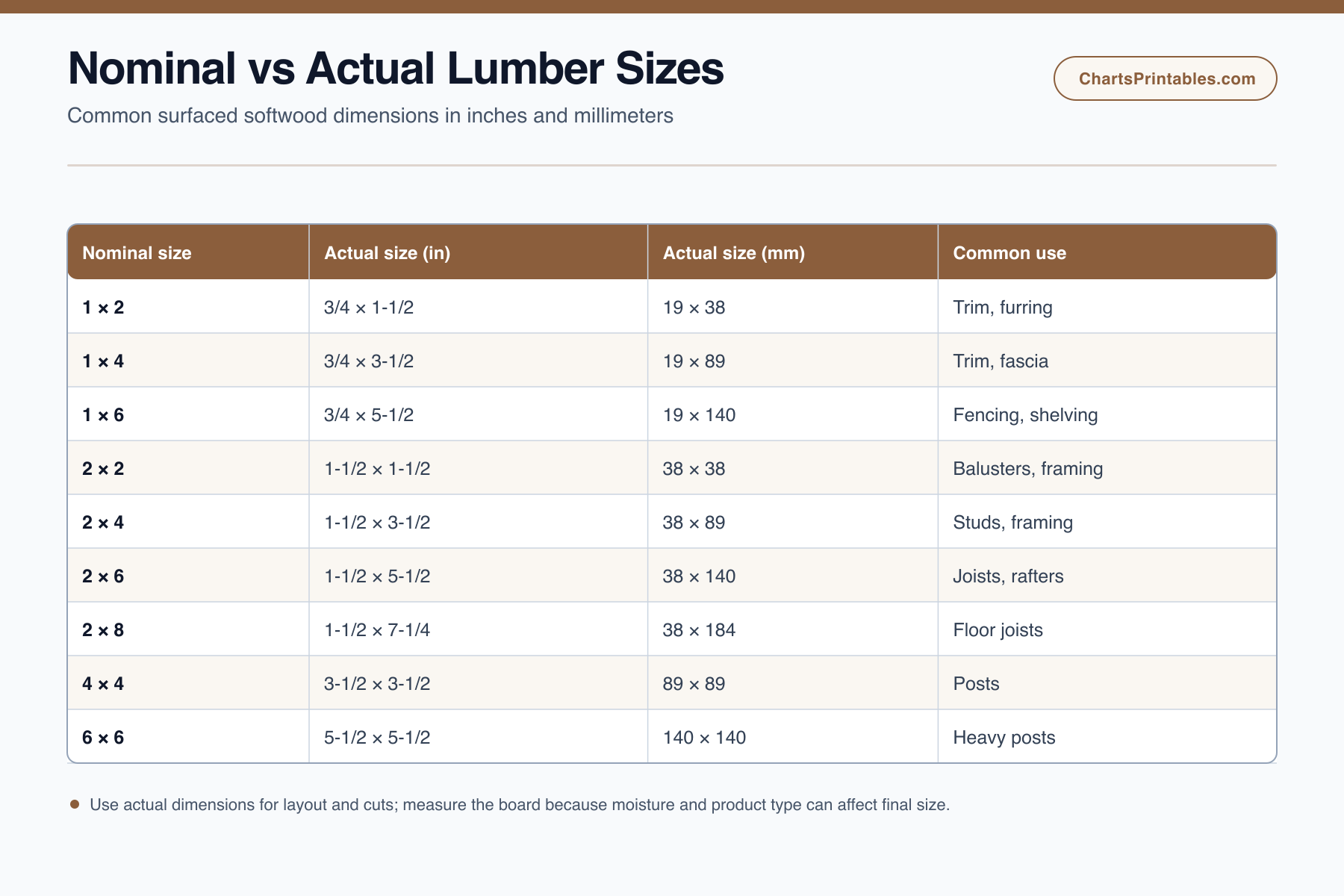
A nominal 2×4 is usually 1-1/2 × 3-1/2 in actual, and a nominal 4×4 is usually 3-1/2 × 3-1/2 in actual.
Use nominal sizes to identify store labels and actual dimensions for layout, joinery, hardware, and cuts. Product type and moisture can affect the measured board, so check the piece before final work.
A nominal 4x4 is usually 3.5 inches by 3.5 inches actual. Use the 3.5-inch actual width when choosing post caps, brackets, anchors, fence hardware, or layout spacing. The store label says 4x4, but the finished surfaced size is smaller after drying and planing.
A nominal 1x4 board is usually 3/4 inch thick by 3-1/2 inches wide after surfacing. Use the actual 3-1/2 inch width for trim runs, shelf parts, face frames, and layout spacing.
A nominal 1x6 board is usually 3/4 inch thick by 5-1/2 inches wide after surfacing. Use the actual 5-1/2 inch width for shelves, fascia, trim boards, and layout cuts. Do not design a project assuming the board is a full 6 inches wide.
Wood trim sizes depend on the profile, product line, and manufacturer. Baseboard, casing, and molding are often sold by nominal profile names, so measure width, thickness, and reveal before planning cuts.
Framing • Softwood • 1 page • portrait
ChartsPrintables.com
Nominal vs Actual Dimensions • Letter
| Nominal Size | Actual (Inch) | Actual (MM) | Common Uses / Notes |
|---|---|---|---|
| 1 x 2 | 3/4" x 1 1/2" | 19 x 38 mm | Trim, Furring |
| 1 x 3 | 3/4" x 2 1/2" | 19 x 64 mm | Baseboards, Trim |
| 1 x 4 | 3/4" x 3 1/2" | 19 x 89 mm | Trim, Fascia |
| 1 x 6 | 3/4" x 5 1/2" | 19 x 140 mm | Fencing, Shelving |
| 1 x 8 | 3/4" x 7 1/4" | 19 x 184 mm | Shelving, Siding |
| 1 x 10 | 3/4" x 9 1/4" | 19 x 235 mm | Trim, Shelving |
| 1 x 12 | 3/4" x 11 1/4" | 19 x 286 mm | Stair treads, Shelving |
| 2 x 2 | 1 1/2" x 1 1/2" | 38 x 38 mm | Balusters, Framing |
| 2 x 3 | 1 1/2" x 2 1/2" | 38 x 64 mm | Framing |
| 2 x 4 | 1 1/2" x 3 1/2" | 38 x 89 mm | Wall Studs, Framing |
| 2 x 6 | 1 1/2" x 5 1/2" | 38 x 140 mm | Joists, Rafters |
| 2 x 8 | 1 1/2" x 7 1/4" | 38 x 184 mm | Floor Joists |
| 2 x 10 | 1 1/2" x 9 1/4" | 38 x 235 mm | Floor Joists, Headers |
| 2 x 12 | 1 1/2" x 11 1/4" | 38 x 286 mm | Stair Stringers |
| 4 x 4 | 3 1/2" x 3 1/2" | 89 x 89 mm | Posts |
| 4 x 6 | 3 1/2" x 5 1/2" | 89 x 140 mm | Posts, Beams |
| 6 x 6 | 5 1/2" x 5 1/2" | 140 x 140 mm | Heavy Posts |
Generated by ChartsPrintables.com • Free to use and share
Rows
17
Type
Softwood
PDF SIZE
≈0KB
Quality
300 DPI
Export Set
One setup, every version you need.
Workshop reference set
Seven watermark-free lookup sheets plus an index, organized for pipe, lumber, bolts, drills, screws, nails and wrenches.
USD 7 one-time · no subscription required
Start with the most common nominal-to-actual sizes, then use the printable chart for the full lumber table. Actual dimensions are the numbers to use for layout and cut planning, but product dimensions can vary. Measure the board before final cuts.
| Nominal Size | Actual Size | Common Use | Notes |
|---|---|---|---|
| 1x2 | 3/4" × 1-1/2" | trim, furring, light frames | 1-by boards are 3/4" thick |
| 1x4 | 3/4" × 3-1/2" | trim, shelves, boards | same actual width as a 2x4 width |
| 1x6 | 3/4" × 5-1/2" | shelves, fascia, boards | target query: actual size of 1x6 |
| 2x4 | 1-1/2" × 3-1/2" | wall studs, frames | most common framing size |
| 2x6 | 1-1/2" × 5-1/2" | deck joists, framing | wider than 2x4 but same thickness |
| 4x4 | 3-1/2" × 3-1/2" | posts, supports | target query: 4x4 wood dimensions |
| 6x6 | 5-1/2" × 5-1/2" | posts, beams | check local structural requirements |
Trim dimensions are less standardized than framing lumber. The numbers below are common store-bought profiles, not a substitute for measuring the actual piece in your hand.
| Trim type | Common actual size | Where it is used | Check before cutting |
|---|---|---|---|
| Baseboard | about 9/16" × 3-1/4" | Covers the wall-to-floor joint | Height, thickness, and profile vary by style. |
| Door casing | about 9/16" × 2-1/4" | Frames interior doors and windows | Match the reveal and profile on existing trim. |
| Quarter round | about 3/4" × 3/4" | Covers small gaps along flooring edges | Confirm the radius and finish before buying. |
| Shoe molding | about 1/2" × 3/4" | A slimmer floor-edge trim than quarter round | Useful when baseboard stays in place during flooring work. |
| Crown molding | sizes vary widely, often 2-1/4" to 5-1/4" tall | Wall-to-ceiling transition | Measure spring angle and projection, not only face height. |
Manufacturer profiles vary. For visible finish work, bring a sample or measure the actual trim with a tape measure before cutting returns, miters, or scarf joints.
Which wood goes where? A quick guide to standard uses.
Structural lumber sizes (2x4, 2x6, 2x10) are standard for wall studs, floor joists, and headers.
Fine woodworking uses the 'Quarter' system for thickness. 4/4 is 1" rough, surfacing to ~13/16".
Pressure-treated lumber is often swollen from moisture. A fresh 2x6 deck board might measure fuller than a kiln-dried one.
Avoid the most common beginner mistake: measuring based on the label instead of the lumber.
Understand why a 2x4 isn't 2"x4". It starts that size (Rough Cut) but shrinks during drying and planing to 1.5"x3.5".
Use 'Dimensional' (2x4) for framing. Use 'Hardwood' (4/4, 8/4) for fine furniture. Use 'Sheet Goods' for cabinets.
Always design with ACTUAL dimensions. Three 2x4s side-by-side measure 4.5", not 6". Use the chart to plan precise cuts.
Why is lumber smaller than its name? Understanding the drying and surfacing process is key to precise measurements.
Commonly used for framing. A 2x4 nominal is 1.5" x 3.5" actual. A 1x6 is 0.75" x 5.5". Always plan your project using these actual dimensions.
Sold by the 'Quarter'. 4/4 is 1" rough, 8/4 is 2" rough. After surfacing (S2S/S4S), thickness typically drops by 3/16".
Nominal 3/4" plywood is usually 23/32" (18mm). This small difference is critical for creating tight-fitting dado joints in cabinetry.
What length screw/nail do you need to join 2x4s? Use this guide to choose the right fastener.
| Application | Fastener Length | Type |
|---|---|---|
| Framing (2x4 to 2x4) | 3" to 3-1/2" | 16d Common Nail |
| Decking (5/4 Board) | 2-1/2" | Deck Screw |
| Sheathing (Plywood) | 2" to 2-1/2" | 8d Nail / Ring Shank |
| Drywall to Stud | 1-1/4" | Drywall Screw (Coarse) |
Nominal lumber names do not tell you the full fastening layout. After checking the actual board thickness, use the Nail Size chart for penny length and gauge, the Screw Size chart for screw diameter and threads, and the drill bit size chart when the plan calls for a pilot hole.
Before drilling pilot holes in actual 2x lumber, confirm both the board thickness and the fastener size. Use the drill bit size chart when the plan calls for a numbered, fractional, or metric pilot bit, then test on scrap when the material or finish matters.
For layout marks written as inch fractions, use the Fraction to Decimal chart to compare decimal measurements before cutting or drilling.
Estimates for standard Pine/Fir. Wet (Green) wood is much heavier. Plan your hardware store trip accordingly.
| Size (8ft Length) | Dry Weight (Approx) | Green/Wet Weight (Approx) |
|---|---|---|
| 2x4 (8ft) | ~9 lbs | ~13 lbs |
| 2x6 (8ft) | ~14 lbs | ~20 lbs |
| 2x8 (8ft) | ~19 lbs | ~27 lbs |
| 2x10 (8ft) | ~24 lbs | ~35 lbs |
| 2x12 (8ft) | ~29 lbs | ~42 lbs |
| 4x4 (8ft) | ~22 lbs | ~35 lbs |
Hardwood is sold by volume, not length. Understand the pricing unit used by lumber yards.
Formula: (Thickness" x Width" x Length") / 144
Example: One 1x6 board that is 8 feet long.
Tip: Always buy extra (10-20%) to account for defects and waste when working with hardwood.
Planning fasteners after checking actual board size? Use Screw Size, Nail Size, and Drill Bit Sizes for nearby workshop references. Use Fraction to Decimal when drawings or cut lists use fractional inch values.
| Number | Fraction | Decimal (in) | Millimeters |
|---|---|---|---|
| #80 | — | 0.0135 | 0.34 |
| #50 | — | 0.0700 | 1.78 |
| #52 | 1/16" | 0.0625 | 1.59 |
| #41 | 3/32" | 0.0938 | 2.38 |
| #22 | 5/32" | 0.1562 | 3.97 |
| #11 | 3/16" | 0.1875 | 4.76 |
| #7 | 13/64" | 0.2031 | 5.16 |
| — | — | 0.2570 | 6.53 |
| — | 3/8" | 0.3750 | 9.53 |
| — | 1/2" | 0.5000 | 12.70 |
Numbered, lettered, metric, and fractional drill bit reference.
View chart| Size | Pilot | Clear |
|---|---|---|
| #4 | 1/16" | 9/64" |
| #6 | 5/64" | 11/64" |
| #8 | 3/32" | 13/64" |
| #10 | 7/64" | 1/4" |
| #12 | 1/8" | 17/64" |
| 1/4" | - | F |
| 5/16" | - | P |
| 3/8" | - | W |
| M4 | 2.5mm | 4.5mm |
| M6 | 3.5mm | 6.6mm |
Identify screw sizes, thread pitches, and head types for woodworking and repairs.
View chart| Size (d) | Length (in) | MM |
|---|---|---|
| 2d | 1" | 25.4 |
| 4d | 1.5" | 38.1 |
| 6d | 2" | 50.8 |
| 8d | 2.5" | 63.5 |
| 10d | 3" | 76.2 |
| 16d | 3.5" | 88.9 |
| 20d | 4" | 101.6 |
| 30d | 4.5" | 114.3 |
| 40d | 5" | 127 |
| 60d | 6" | 152.4 |
Convert penny sizes (d) to inches and millimeters. Includes gauge and count per lb for Common, Finish, Box, and Roofing nails.
View chart| Fraction | Decimal | Percent |
|---|---|---|
| 1/64 | 0.0156 | 1.56% |
| 1/32 | 0.0313 | 3.13% |
| 1/16 | 0.0625 | 6.25% |
| 1/8 | 0.1250 | 12.5% |
| 3/16 | 0.1875 | 18.8% |
| 1/4 | 0.2500 | 25% |
| 5/16 | 0.3125 | 31.3% |
| 3/8 | 0.3750 | 37.5% |
| 1/2 | 0.5000 | 50% |
| 3/4 | 0.7500 | 75% |
Fractions from 1/64 to whole numbers for math education and precision cutting.
View chartCommon questions about wood dimensions.