What wrench fits an M6 bolt?
Many common M6 hex bolts use a 10 mm wrench opening, but fastener standards and head styles can vary.
Find the wrench or socket opening that matches a metric or SAE fastener head. Use the chart for common bolt-head references, close metric-to-inch comparisons, and fit checks before applying torque.
A wrench size is the distance across the flats of the fastener head. It is not always the same as the bolt thread diameter. When the job matters, measure the head, check the fastener standard, and use a snug 6-point tool for high-torque work.
Quick answer
What wrench fits an M6 bolt?
Many common M6 hex bolts use a 10 mm wrench opening, but fastener standards and head styles can vary.
What wrench fits an M8 bolt?
Many common M8 hex bolts use a 13 mm wrench opening. Some standards or special heads may differ, so measure across flats when fit matters.
What wrench fits an M10 bolt?
M10 can commonly use 16 mm or 17 mm depending on ISO/DIN-style references and head pattern. Do not assume “M10” means a 10 mm wrench.
Is 1/2 inch the same as 13 mm?
No. 1/2 inch is 12.7 mm. A 13 mm wrench is close but slightly larger, so it can slip on a 1/2 inch fastener under torque.
Use close equivalents only for light checks or emergency reference. For stuck, rusted, or high-torque fasteners, use the correct measured size and the correct tool system.
Auto Mechanic • Metric & SAE • all • 1 page • portrait
ChartsPrintables.com
Metric & SAE Wrench Comparison • A4
| Wrench Size | Actual (mm) | Metric Hex | SAE Hex | Metric Socket | SAE Socket | Heavy Hex |
|---|---|---|---|---|---|---|
| 0.050" | 1.27 | - | - | - | #3, #4 | - |
| 1.5mm | 1.50 | - | - | M1.6, M2 | - | - |
| 1/16" | 1.59 | - | - | - | #5, #6 | - |
| 5/64" | 1.98 | - | - | - | #8 | - |
| 2mm | 2.00 | - | - | M2.5 | - | - |
| 3/32" | 2.38 | - | - | - | #10, 1/8" | - |
| 2.5mm | 2.50 | - | - | M3 | - | - |
| 7/64" | 2.78 | - | - | - | #6 | - |
| 3mm | 3.00 | - | - | M4 | - | - |
| 9/64" | 3.57 | - | - | - | #8 | - |
| 5/32" | 3.97 | - | #6 (Small Pattern) | - | #10 | - |
| 4mm | 4.00 | - | - | M5 | - | - |
| 3/16" | 4.76 | - | #8 (Small Pattern) | - | 1/4" | - |
| 5mm | 5.00 | - | - | M6 | - | - |
| 5.5mm | 5.50 | M3 | - | - | - | - |
| 6mm | 6.00 | - | - | M8 | - | - |
| 1/4" | 6.35 | - | #6 | - | 5/16" | - |
| 7mm | 7.00 | M4 | - | - | - | - |
| 5/16" | 7.94 | - | #8, #10 | - | 3/8" | - |
| 8mm | 8.00 | M5 | - | M10 | - | - |
| 11/32" | 8.73 | - | #8 (Heavy), #10 (Small) | - | - | - |
| 3/8" | 9.52 | - | #10 (Heavy), 1/4" (Small) | - | 7/16", 1/2" | - |
| 10mm | 10.00 | M6 | - | M12 | - | - |
| 7/16" | 11.11 | - | 1/4" | - | - | - |
| 12mm | 12.00 | - | - | M14 | - | - |
| 1/2" | 12.70 | - | 5/16" | - | 5/8" | - |
| 13mm | 13.00 | M8 | - | - | - | - |
| 14mm | 14.00 | - | - | M16 | - | - |
| 9/16" | 14.29 | - | 3/8" | - | - | - |
| 5/8" | 15.88 | - | 7/16" | - | 3/4" | - |
| 16mm | 16.00 | M10 (ISO) | - | - | - | - |
| 17mm | 17.00 | M10 (DIN) | - | M20 | - | - |
| 18mm | 18.00 | M12 (ISO) | - | - | - | - |
| 19mm | 19.00 | M12 (DIN) | - | M24 | - | - |
| 3/4" | 19.05 | - | 1/2" | - | 7/8", 1" | - |
| 13/16" | 20.64 | - | 9/16" | - | - | - |
| 21mm | 21.00 | M14 (ISO) | - | - | - | - |
| 22mm | 22.00 | M14 (DIN) | - | - | - | - |
| 7/8" | 22.22 | - | - | - | - | 1/2" (Heavy) |
| 15/16" | 23.81 | - | 5/8" | - | - | - |
| 24mm | 24.00 | M16 | - | - | - | - |
| 1-1/16" | 26.99 | - | - | - | - | 5/8" (Heavy) |
| 27mm | 27.00 | M18 | - | - | - | - |
| 1-1/8" | 28.57 | - | 3/4" | - | - | - |
| 30mm | 30.00 | M20 | - | - | - | - |
| 1-1/4" | 31.75 | - | - | - | - | 3/4" (Heavy) |
| 32mm | 32.00 | M22 (DIN) | - | - | - | - |
| 1-5/16" | 33.34 | - | 7/8" | - | - | - |
| 34mm | 34.00 | M22 | - | - | - | - |
| 36mm | 36.00 | M24 | - | - | - | - |
| 1-7/16" | 36.51 | - | - | - | - | 7/8" (Heavy) |
| 1-1/2" | 38.10 | - | 1" | - | - | - |
| 1-5/8" | 41.27 | - | - | - | - | 1" (Heavy) |
Generated by ChartsPrintables.com • Free to use and share
Rows
53
System
Metric & SAE • all
PDF FILE SIZE
≈0KB
Quality
300 DPI
Export Set
One setup, every version you need.
Fastener & Drill Pack
Seven focused, watermark-free references plus an index for bolts, screws, drill bits, nails, wrenches, tap drills and fastener markings.
USD 7 one-time · no subscription required
Visual quick reference
Some metric and SAE wrench openings are numerically close—19 mm and 3/4 inch differ by only 0.05 mm—but close sizes are not automatically interchangeable.
Use the table to identify nearby nominal openings, then choose the correctly marked tool that fits the fastener without rocking. Even a small difference can matter when torque is applied.
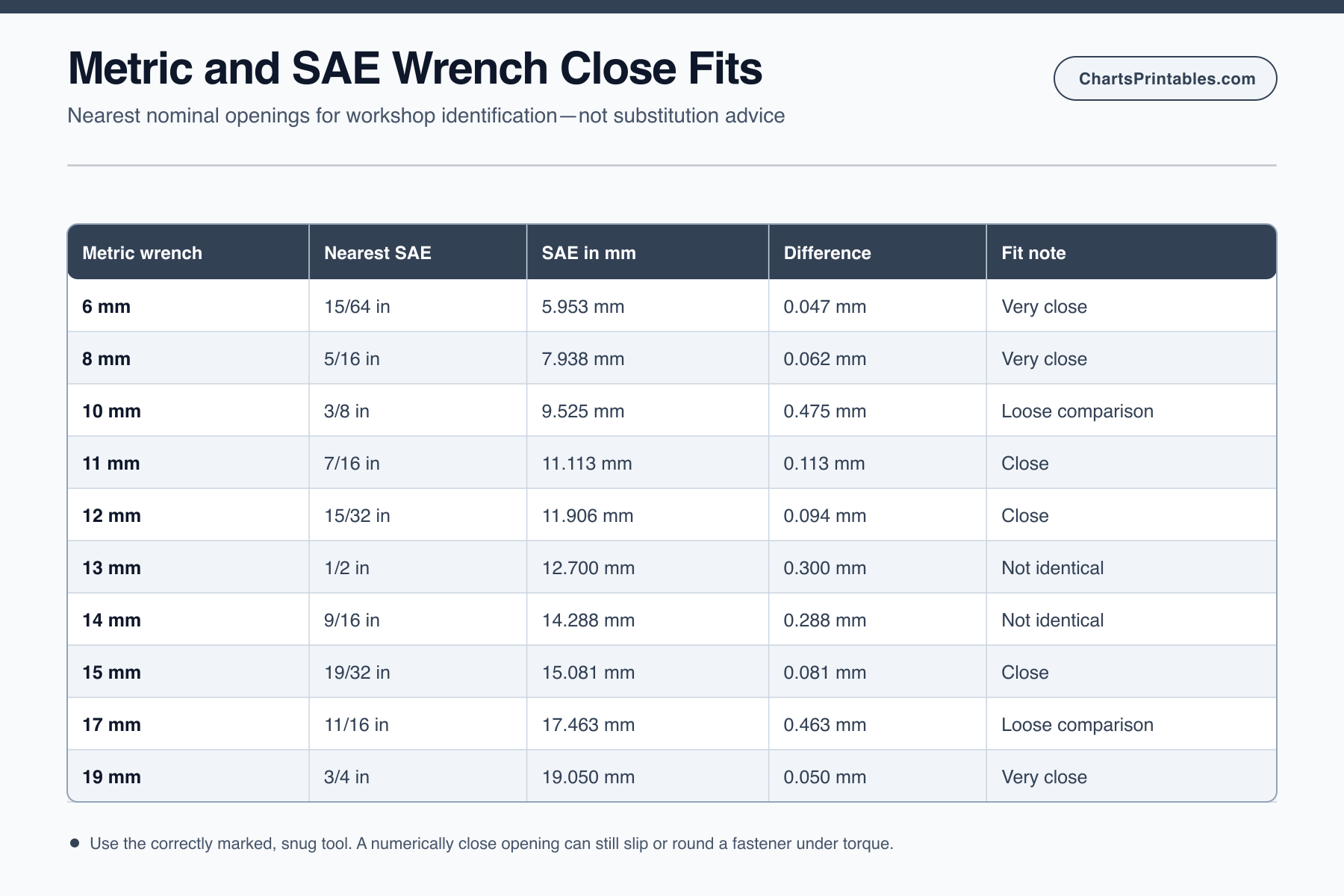
Some metric and SAE sizes are close enough to look interchangeable, but a small gap can matter under torque. Use these as comparison notes, not as a license to force the wrong tool onto a fastener.
Close comparison sizes
Note: 13 mm is slightly larger than 1/2 inch. Treat close matches as low-torque, temporary references only; use the correct wrench or socket when fit matters.
For stubborn, rusted, or high-torque fasteners, a snug 6-point socket or wrench is usually the safer first choice. 12-point tools are easier to align in tight spaces, but they are less forgiving on worn or undersized heads.
Why does your 17mm wrench fit some M10 bolts but not others? It depends on the engineering standard used.
Use the chart to narrow the likely size, then confirm the actual fit on the fastener before applying torque.
Use calipers to measure the distance between the two parallel flat sides of the bolt head. This is the wrench size.
Look for markings. Numbers (8.8, 10.9) mean Metric tools. Hash marks or letters mean SAE (Inch) tools.
Check for a snug fit. If the wrench rocks on the fastener head, stop and confirm the size, system, and head condition before applying torque.
A wrench chart identifies common head sizes, but it does not identify the full fastener by itself. If you know the head size but not the thread, cross-check the Bolt Size chart for diameter and pitch. If you are preparing a tapped hole, use the Drill Bit Sizes chart to verify the numbered or letter drill before cutting threads.
For screws instead of bolts, use the screw diameter and thread reference before choosing a driver or pilot hole.
Different bolts require different driving tools. Know when to use each.
Standard combination wrenches are ideal for most tasks. Socket sets are preferred for engine bays where space is limited.
Precision equipment often uses Heavy Hex or Socket Cap bolts that require heavy-duty impact sockets or Hex keys.
Flat-pack furniture often relies on metric hex keys. Keep a set of 4 mm, 5 mm, and 6 mm keys handy.
Use these related workshop charts when you need to identify the fastener, check a pilot hole, or convert metric dimensions before choosing a wrench.
| Size | Pitch/TPI | Head |
|---|---|---|
| M3 | 0.5 | 5.5 |
| M4 | 0.7 | 7.0 |
| M5 | 0.8 | 8.0 |
| M6 | 1.0 | 10.0 |
| M8 | 1.25 | 13.0 |
| 1/4" | 20 | 7/16" |
| 5/16" | 18 | 1/2" |
| 3/8" | 16 | 9/16" |
| Size | Pilot | Clear |
|---|---|---|
| #4 | 1/16" | 9/64" |
| #6 | 5/64" | 11/64" |
| #8 | 3/32" | 13/64" |
| #10 | 7/64" | 1/4" |
| #12 | 1/8" | 17/64" |
| 1/4" | - | F |
| 5/16" | - | P |
| 3/8" | - | W |
| M4 | 2.5mm | 4.5mm |
| M6 | 3.5mm | 6.6mm |
Identify screw sizes, thread pitches, and head types for woodworking and repairs.
Customize & Download| Number | Fraction | Decimal (in) | Millimeters |
|---|---|---|---|
| #80 | — | 0.0135 | 0.34 |
| #50 | — | 0.0700 | 1.78 |
| #52 | 1/16" | 0.0625 | 1.59 |
| #41 | 3/32" | 0.0938 | 2.38 |
| #22 | 5/32" | 0.1562 | 3.97 |
| #11 | 3/16" | 0.1875 | 4.76 |
| #7 | 13/64" | 0.2031 | 5.16 |
| — | — | 0.2570 | 6.53 |
| — | 3/8" | 0.3750 | 9.53 |
| — | 1/2" | 0.5000 | 12.70 |
| Millimeters | Decimal (in) | Fraction (in) |
|---|---|---|
| 0.5 | 0.020 | 0 |
| 1 | 0.039 | 1/16 |
| 6.35 | 0.250 | 1/4 |
| 12.7 | 0.500 | 1/2 |
| 19 | 0.748 | 3/4 |
| 25.4 | 1.000 | 1 |
| 38.1 | 1.500 | 1 1/2 |
| 50.8 | 2.000 | 2 |
| 76.2 | 3.000 | 3 |
| 101.6 | 4.000 | 4 |
Convert millimeters to inches with decimals and fractions for woodworking and engineering.
Customize & Download