NPS 1/2 pipe
NPS 1/2 pipe is commonly mapped to DN 15 and has an outside diameter of 0.840 in. The inside diameter depends on the selected schedule.
NPS, DN, Schedule 40/80, OD & ID
Pipe size is usually listed by nominal pipe size (NPS) or DN, not by the exact measured diameter. For example, NPS 1/2 pipe is commonly mapped to DN 15 and has an outside diameter of 0.840 in.
Use this chart to compare NPS, DN, outside diameter, inside diameter, wall thickness, and Schedule 40 / Schedule 80 values. The outside diameter stays fixed for the same NPS, while the inside diameter changes with schedule and wall thickness.
For pressure-rated, code-regulated, fuel gas, fire protection, structural, or other safety-critical work, verify the applicable material standard, pressure class, local code, and manufacturer data, or consult a qualified professional.
Start with the nominal size, then check the measured outside diameter and the schedule-specific wall thickness or inside diameter. These common examples show why the name of a pipe size is not the same as its measured diameter.
ID changes by schedule. Use the chart row before using an inside-diameter value.
A common small-pipe reference. DN 25 is not 25 mm OD.
Use OD for outside-fit checks. Use schedule for wall thickness and ID.
For the same NPS, Schedule 80 generally has a thicker wall and smaller ID than Schedule 40.
Visual quick reference
NPS 1/2 maps to DN 15 and has a 0.840 in outside diameter; NPS 2 maps to DN 50 and has a 2.375 in outside diameter.
NPS and DN are nominal size labels rather than measured diameters. For one NPS, outside diameter stays fixed while schedule changes the wall thickness and inside diameter.
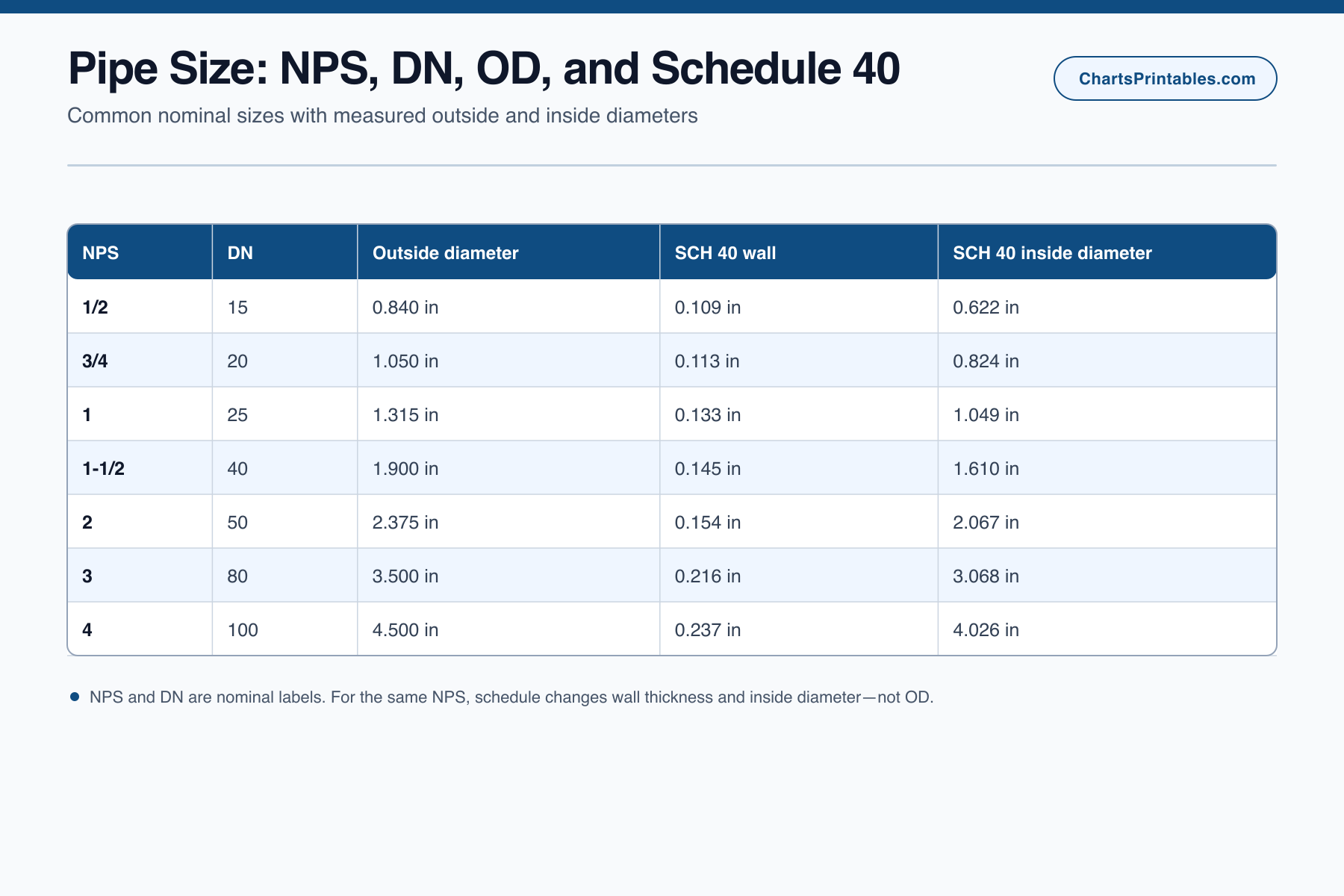
The table compares nominal pipe size, DN, outside diameter, schedule, wall thickness, inside diameter, and weight. Use it for quick reference, printing, shop planning, and measurement checks. Do not use a dimension chart alone as the final specification for regulated or pressure-rated work.
Residential Plumbing • 1/2 → 8 • A4 • 1 page • portrait
ChartsPrintables.com
Standard: NPS • Range: 1/2 - 8 • A4
| NPS | DN | OD | Schedule | Wall | ID | Weight |
|---|---|---|---|---|---|---|
| 1/2 | DN 15 | 0.840" / 21.3mm | SCH 40 | 0.109" / 2.77mm | 0.622" / 15.76mm | 0.85 lb/ft / 1.27 kg/m |
| 1/2 | DN 15 | 0.840" / 21.3mm | SCH 80 | 0.147" / 3.73mm | 0.546" / 13.84mm | 1.09 lb/ft / 1.62 kg/m |
| 3/4 | DN 20 | 1.050" / 26.7mm | SCH 40 | 0.113" / 2.87mm | 0.824" / 20.96mm | 1.13 lb/ft / 1.69 kg/m |
| 3/4 | DN 20 | 1.050" / 26.7mm | SCH 80 | 0.154" / 3.91mm | 0.742" / 18.88mm | 1.48 lb/ft / 2.20 kg/m |
| 1 | DN 25 | 1.315" / 33.4mm | SCH 40 | 0.133" / 3.38mm | 1.049" / 26.64mm | 1.68 lb/ft / 2.50 kg/m |
| 1 | DN 25 | 1.315" / 33.4mm | SCH 80 | 0.179" / 4.55mm | 0.957" / 24.30mm | 2.17 lb/ft / 3.24 kg/m |
| 1-1/4 | DN 32 | 1.660" / 42.2mm | SCH 40 | 0.140" / 3.56mm | 1.380" / 35.08mm | 2.27 lb/ft / 3.39 kg/m |
| 1-1/4 | DN 32 | 1.660" / 42.2mm | SCH 80 | 0.191" / 4.85mm | 1.278" / 32.50mm | 3.00 lb/ft / 4.47 kg/m |
| 1-1/2 | DN 40 | 1.900" / 48.3mm | SCH 40 | 0.145" / 3.68mm | 1.610" / 40.94mm | 2.72 lb/ft / 4.05 kg/m |
| 1-1/2 | DN 40 | 1.900" / 48.3mm | SCH 80 | 0.200" / 5.08mm | 1.500" / 38.14mm | 3.63 lb/ft / 5.41 kg/m |
| 2 | DN 50 | 2.375" / 60.3mm | SCH 40 | 0.154" / 3.91mm | 2.067" / 52.48mm | 3.66 lb/ft / 5.44 kg/m |
| 2 | DN 50 | 2.375" / 60.3mm | SCH 80 | 0.218" / 5.54mm | 1.939" / 49.22mm | 5.03 lb/ft / 7.48 kg/m |
| 2-1/2 | DN 65 | 2.875" / 73.0mm | SCH 40 | 0.203" / 5.16mm | 2.469" / 62.68mm | 5.80 lb/ft / 8.63 kg/m |
| 2-1/2 | DN 65 | 2.875" / 73.0mm | SCH 80 | 0.276" / 7.01mm | 2.323" / 58.98mm | 7.67 lb/ft / 11.41 kg/m |
| 3 | DN 80 | 3.500" / 88.9mm | SCH 40 | 0.216" / 5.49mm | 3.068" / 77.92mm | 7.58 lb/ft / 11.29 kg/m |
| 3 | DN 80 | 3.500" / 88.9mm | SCH 80 | 0.300" / 7.62mm | 2.900" / 73.66mm | 10.26 lb/ft / 15.27 kg/m |
| 3-1/2 | DN 90 | 4.000" / 101.6mm | SCH 40 | 0.226" / 5.74mm | 3.548" / 90.12mm | 9.12 lb/ft / 13.57 kg/m |
| 3-1/2 | DN 90 | 4.000" / 101.6mm | SCH 80 | 0.318" / 8.08mm | 3.364" / 85.44mm | 12.52 lb/ft / 18.63 kg/m |
| 4 | DN 100 | 4.500" / 114.3mm | SCH 40 | 0.237" / 6.02mm | 4.026" / 102.26mm | 10.80 lb/ft / 16.07 kg/m |
| 4 | DN 100 | 4.500" / 114.3mm | SCH 80 | 0.337" / 8.56mm | 3.826" / 97.18mm | 15.00 lb/ft / 22.32 kg/m |
| 5 | DN 125 | 5.563" / 141.3mm | SCH 40 | 0.258" / 6.55mm | 5.047" / 128.20mm | 14.63 lb/ft / 21.77 kg/m |
| 5 | DN 125 | 5.563" / 141.3mm | SCH 80 | 0.375" / 9.53mm | 4.813" / 122.24mm | 20.80 lb/ft / 30.97 kg/m |
| 6 | DN 150 | 6.625" / 168.3mm | SCH 40 | 0.280" / 7.11mm | 6.065" / 154.08mm | 18.99 lb/ft / 28.26 kg/m |
| 6 | DN 150 | 6.625" / 168.3mm | SCH 80 | 0.432" / 10.97mm | 5.761" / 146.36mm | 28.60 lb/ft / 42.56 kg/m |
| 8 | DN 200 | 8.625" / 219.1mm | SCH 40 | 0.322" / 8.18mm | 7.981" / 202.74mm | 28.58 lb/ft / 42.55 kg/m |
| 8 | DN 200 | 8.625" / 219.1mm | SCH 80 | 0.500" / 12.70mm | 7.625" / 193.70mm | 43.43 lb/ft / 64.64 kg/m |
Generated by ChartsPrintables.com • Free to use and share
Rows
26
Range
1/2 → 8 • A4
PDF FILE SIZE
≈0KB
Quality
300 DPI
Export Set
One setup, every version you need.
Workshop reference set
Seven watermark-free lookup sheets plus an index, organized for pipe, lumber, bolts, drills, screws, nails and wrenches.
USD 7 one-time · no subscription required
Read across one row in this order: nominal size first, outside diameter next, then schedule-specific wall thickness and inside diameter.
Find the NPS or DN size class. NPS and DN are nominal designations. They name the size class; they are not exact measured diameters.
Use the OD column for fittings, clamps, hangers, sleeves, and wall penetrations.
Choose the schedule to compare wall thickness and read the corresponding inside diameter. For the same NPS, a thicker wall means a smaller inside diameter.
Verify material, pressure class, manufacturer data, applicable standard, and local code requirements before final specification.
These examples are useful because the nominal size can look smaller than the measured outside diameter, especially in common NPS sizes below 14.
NPS 1/2 pipe is commonly mapped to DN 15 and has an outside diameter of 0.840 in. The inside diameter depends on the selected schedule.
NPS 1 pipe is commonly mapped to DN 25 and has an outside diameter of 1.315 in. DN 25 is a nominal designation, not a 25 mm outside diameter.
NPS 2 pipe is commonly mapped to DN 50 and has an outside diameter of 2.375 in. Check Schedule 40, Schedule 80, or the required schedule before using wall thickness or inside diameter.
These examples show why nominal pipe size is not the same as measured outside diameter. Always use the schedule row when you need wall thickness or inside diameter.
Use these definitions before comparing rows. The most common mistake is treating a nominal label as a measured diameter.
For the same NPS, Schedule 40 and Schedule 80 generally use the same outside diameter. Schedule 80 usually has a thicker wall, so its inside diameter is smaller than Schedule 40.
Schedule is a wall thickness series. It helps compare wall thickness and inside diameter, but it is not the full engineering specification. Pressure suitability depends on pipe material, temperature, joining method, corrosion allowance, applicable standard, manufacturer rating, and local code requirements.
This chart is a general dimension reference. Do not use it as the only source for pressure-rated, fuel gas, fire protection, structural, or code-regulated installations. Verify the material standard, pressure class, manufacturer data, and local code requirements, or consult a qualified professional.
After you identify the pipe size, these charts can help with related measurement tasks such as pressure unit conversion, fractional clearances, material density, and workshop layout references.
| Fraction | Decimal | Percent |
|---|---|---|
| 1/64 | 0.0156 | 1.56% |
| 1/32 | 0.0313 | 3.13% |
| 1/16 | 0.0625 | 6.25% |
| 1/8 | 0.1250 | 12.5% |
| 3/16 | 0.1875 | 18.8% |
| 1/4 | 0.2500 | 25% |
| 5/16 | 0.3125 | 31.3% |
| 3/8 | 0.3750 | 37.5% |
| 1/2 | 0.5000 | 50% |
| 3/4 | 0.7500 | 75% |
Use this when pipe clearances, holes, sleeves, or field measurements are written as inch fractions.
View chart| Material | kg/m³ | SG |
|---|---|---|
| Water | 1000 | 1.00 |
| Aluminum | 2700 | 2.70 |
| Steel | 7850 | 7.85 |
| Gold | 19320 | 19.3 |
| Oak | 700 | 0.70 |
| Pine | 420 | 0.42 |
| Concrete | 2400 | 2.40 |
| Glass | 2580 | 2.58 |
| PVC | 1380 | 1.38 |
| Gasoline | 720 | 0.72 |
Use this for material or fluid density references when a project needs a separate weight or density lookup.
View chart| PSI | Bar | kPa |
|---|---|---|
| 10 | 0.69 | 69 |
| 20 | 1.38 | 138 |
| 30 | 2.07 | 207 |
| 32 | 2.21 | 221 |
| 35 | 2.41 | 241 |
| 40 | 2.76 | 276 |
| 50 | 3.45 | 345 |
| 60 | 4.14 | 414 |
| 80 | 5.52 | 552 |
| 100 | 6.89 | 689 |
Use this for pressure unit conversion only; it does not replace pipe pressure-rating verification.
View chart| Nominal | Actual Size |
|---|---|
| 1 x 2 | 3/4" x 1 1/2" |
| 1 x 3 | 3/4" x 2 1/2" |
| 1 x 4 | 3/4" x 3 1/2" |
| 2 x 4 | 1 1/2" x 3 1/2" |
| 2 x 6 | 1 1/2" x 5 1/2" |
| 2 x 8 | 1 1/2" x 7 1/4" |
| 4 x 4 | 3 1/2" x 3 1/2" |
| 4/4 | 13/16" |
| 8/4 | 1 3/4" |
| 3/4" Ply | 23/32" |
Use this for workshop material size planning when pipe layout connects to framing, boards, or shop fixtures.
View chartExplore more: All Charts · Categories · Use Cases
Common questions about pipe sizing, NPS, DN, outside diameter, inside diameter, and schedule.