Printable reference and chart builder

Shoe Size Chart & Converter (US, UK, EU, CM & Inches)

Use the shoe size chart with a measured foot length

Start with a foot measurement, not the size printed on an old pair. Place your foot on paper, keep the pencil upright, and mark the outermost heel point and the end of the longest toe. Measure that distance in centimeters. Repeat for the other foot and use the larger result. Then open the shoe size chart, choose the adult or kids table, and compare the measured length with the CM or JP column.

The number you reach is a starting reference. A shoe size chart can compare regional labels, but it cannot account for every last, width, upper material, sock, insole, or model. Before buying, check the seller or manufacturer size guide for that exact product. If its chart conflicts with a general conversion, use the product-specific chart and its stated measuring method.

For a printable reference, follow one short flow: measure, compare, customize, then print or export. Keep the measured length beside the regional size so the shoe size chart remains useful when a store lists US, UK, EU, CM, or JP values differently.

Use this shoe size chart alongside the measured length and the product’s own instructions.

  • Measure both feet from heel to longest toe.
  • Use the larger measurement when the two feet differ.
  • Compare the shoe size chart CM or JP length before relying on a regional size number.
  • Confirm the result against the exact seller or manufacturer chart.

Use a shoe size chart: measure, compare, customize, and print

The builder turns the shoe size chart into a reference you can take shopping. First select men's, women's, or kids' sizes. Keep the columns you expect to see, such as US, UK, EU, and CM. Add inches only if that unit helps your measurement workflow. Preview the table before exporting so the heading and columns match the person you measured.

A saved shoe size chart is most useful when it carries context. Note whether the measurement was taken with the socks that will be worn, which foot was larger, and which product chart you checked. Those details prevent a regional conversion from being mistaken for a fit promise. The printable does not inspect a foot, choose a shoe width, or approve a purchase.

A saved shoe size chart works best when it names the audience and columns being compared.

  • Measure for the shoe size chart: record both heel-to-toe lengths.
  • Compare in the shoe size chart: use the larger length in the CM or JP column.
  • Customize the shoe size chart: choose audience, columns, paper size, and orientation.
  • Print or export the shoe size chart: keep it as a reference, then confirm the product chart.

How to measure for a shoe size chart

Tape paper to a hard floor so it cannot slide. Wear the socks you expect to use with the shoes. Stand with your weight on the foot and keep the pen or pencil straight up while marking the heel and longest toe. A tilted pencil can add space around the outline, so measure between the actual end points rather than the widest parts of the traced line.

Repeat the process on the other foot. Feet can differ, and the shoe size chart should be checked with the larger heel-to-toe measurement. Record centimeters to one decimal place if your ruler supports it. Do not add a universal clearance amount to the measurement: toe room and sock allowance depend on the footwear design and the manufacturer's own chart.

If the result sits between two rows, do not automatically force it to the nearest regional number. Check whether the seller chart defines the measurement as foot length, inside length, or another value. The shoe size chart on this page compares labels and displayed lengths; it does not know the construction or intended fit of the pair you are considering.

Record the measurement date with the shoe size chart so a later comparison uses current information.

  • Use a hard, level floor and secure the paper.
  • Wear the intended socks and keep the measuring tool upright.
  • Mark heel to longest toe, then measure in centimeters.
  • Repeat for the second foot and retain the larger value.
  • Use the product-specific shoe size chart and measuring instructions when they differ.
3/3 free PDF/PNG downloads today
Quick Presets:

Preview & Download

Men's Standard US 6 - 16

ChartsPrintables.com

Men's Shoe Size Chart

International Conversion (US, UK, EU, CM)

US / CanadaUK / AusEurope (EU)CM (Mondopoint)
65.538.524.0
6.563924.5
76.54025.0
7.5740.525.5
87.54126.0
8.584226.5
98.542.527.0
9.594327.5
109.54428.0
10.51044.528.5
1110.54529.0
11.51145.529.5
1211.54630.0
1312.547.531.0
1413.548.532.0
1514.549.533.0
1615.550.534.0

Generated by ChartsPrintables.com • Chart for personal use or internal reference • Share the page link

File Details

Sizes

17

Range

US 6 - 16

PDF SIZE

0KB

Quality

300 DPI

How to read the shoe size chart columns

Read across one row rather than converting each regional label separately. The US, UK, and EU cells are approximate equivalents for the displayed CM value. CM or JP is useful because it carries a length comparison into a second store, but the label still needs to be checked against that seller's definition. The same regional number can feel different when a model uses a different last or width.

Men's, women's, and kids' rows are separate for a reason. Do not use an adult offset as a universal shortcut for children, and do not assume a men's-to-women's difference applies to every model. Select the correct table in the builder, then use the shoe size chart as a cross-region reference. If a unisex product publishes its own mapping, follow that mapping.

Rounding can move a measurement near a row boundary. Keep the original measured length even if the visible shoe size chart rounds to one decimal place. When two tables disagree, compare their stated measurement methods before deciding that one number is more accurate.

Read each shoe size chart row across from length to regional labels instead of chaining separate conversions.

Adult shoe size chart scenarios

For online shopping, use the shoe size chart to translate the size system you know into the system shown by the seller. Then compare the measured CM length with the seller's row. This two-part check is stronger than copying a US number into an EU dropdown because it preserves both the regional reference and the physical measurement.

For travel, save a compact shoe size chart with the two regional columns you expect to use and the CM column between them. A traveler who knows only a US size can find an approximate UK or EU label, but trying on the shoe remains the better check when it is available. The printable helps with language and labeling; it does not predict comfort.

For a household reference, create separate tables for different people instead of writing several measurements into one unlabeled chart. Record the date, audience, larger-foot length, and intended sock type. Feet and preferences can change, so remeasure before a later purchase rather than treating an old shoe size chart as permanent personal data.

For adult shopping, the shoe size chart is a cross-check, not a substitute for trying the footwear on.

Children's shoe size chart: measure instead of guessing by age

Age bands can help someone open the likely part of a children's shoe size chart, but they are not measurements. Children of the same age can have different foot lengths, widths, and growth patterns. Keep the current age table clearly labeled as an estimate, then measure both feet before selecting a row or ordering a pair.

Use the larger foot and check the child's movement in the actual shoe when possible. A shoe size chart cannot tell whether the heel slips, the toe box pinches, or the child is changing gait because the shoe feels uncomfortable. For a repeat purchase, remeasure instead of assuming the previous size plus one step will fit.

When printing a children's shoe size chart, include the CM column and write the measurement date beside it. That makes growth visible without turning an age estimate into a fit rule. If a retailer provides separate infant, toddler, little-kid, or youth ranges, use its labels because category boundaries are not identical across sellers.

For children, update the shoe size chart reference whenever a fresh foot measurement is taken.

Age groupExisting US referenceExisting CM referenceRequired label
0–6 months1–28–9.5 cmEstimate only; measure both feet
6–12 months2.5–410–11.5 cmEstimate only; measure both feet
1–2 years4.5–6.512–14 cmEstimate only; measure both feet
2–4 years7–9.514.5–16.5 cmEstimate only; measure both feet
4–6 years10–1217–18.5 cmEstimate only; measure both feet
6–8 years12.5–2Y19–21 cmEstimate only; measure both feet
Estimated shoe size chart age ranges retained as orientation only; measurement overrides age.

Shoe size chart limits: width, socks, and shoe lasts change the result

Length is only one part of fit. Width letters can change meaning across audience, market, and manufacturer, so the retained width table must be presented as a common reference rather than a universal standard. A shoe size chart that lands on the expected length may still feel tight across the forefoot or loose at the heel.

Measure while wearing the socks planned for the shoe. A thick hiking sock, thin dress sock, removable insole, or orthotic can change the usable space. The shoe's last also changes shape and volume. Two models with the same printed size can fit differently even when the shoe size chart shows the same regional conversion.

Use the width table to understand the labels you may encounter, then read the product page for the model's available widths and fit notes. Do not size up only to solve width without checking the seller guidance; extra length can create a different problem.

Pair the shoe size chart with the model’s published width options and fit notes.

Width labelCommon men's referenceCommon women's reference
AA / 2ANarrowExtra narrow
BNarrowMedium in many charts
DMedium in many chartsWide in many charts
2E / EEWide in many chartsExtra wide in many charts
4E / EEEEExtra wide in many chartsCheck manufacturer chart
Common shoe size chart width-label reference; manufacturer labels take priority.

Use the exact product shoe size chart instead of brand-wide fit rules

Do not rely on a brand-wide “runs small,” “runs large,” “narrow,” or “true to size” rule. Different models from the same company can use different lasts, materials, and intended fits. Use this shoe size chart as a neutral starting reference, not as a promise about every model from a brand.

For each product, compare your larger-foot length with the seller’s current shoe size chart and read its model notes. If the page lists unisex sizing, wide options, or a product-specific conversion, follow that information. Reviews may describe individual experiences, but they do not replace the published measuring method or trying the shoe on.

Keep the measured length and the exact product reference together. This shoe size chart compares regional labels and displayed lengths; it does not create a brand affiliation, endorsement, or model-specific fit recommendation.

Keep the shoe size chart beside the exact product guide used for the final decision.

How a shoe size chart compares US, UK, EU, and CM or JP entries

US, UK, and EU are labeling systems, not direct measurements of comfort. The shoe size chart places their common equivalents on one row so a shopper can compare markets. The row is approximate because manufacturers can map their products differently and because fit depends on more than length.

The CM or JP column is a useful handoff when it represents foot length. Keep the measured value beside the table and verify how the seller defines its column. Do not describe CM or JP as universally the most accurate system, and do not present this page as ISO-certified. The narrower claim is enough: length gives you a second comparison point when regional labels differ.

For ski boots, retain the Mondopoint reference table but remove fixed Performance, Average, or Comfort fit labels. Boot shell shape, liner, intended use, and professional fitting affect the result. Use the shoe size chart to locate a starting length, then use the boot maker's chart or a qualified boot fitter for the final choice.

A shoe size chart is easier to compare when the original heel-to-toe length stays visible.

Mondopoint referenceExisting US men's referenceExisting US women's referenceRequired handoff
23.55.56.5Check boot-maker chart and shell fit
24.56.57.5Check boot-maker chart and shell fit
25.57.58.5Check boot-maker chart and shell fit
26.58.59.5Check boot-maker chart and shell fit
27.59.510.5Check boot-maker chart and shell fit
Retained shoe size chart ski-boot starting references with bounded wording.

Shoe size chart limitations

A shoe size chart converts or compares labels; it does not measure width, instep height, arch position, heel shape, or toe-box volume. It also does not know the last, materials, lacing, liner, insole, socks, intended activity, or the way a person prefers a shoe to feel. Use the table as a starting reference, not a guarantee of fit or comfort.

Age-based rows are estimates. Adult offsets, men's-to-women's shortcuts, and EU or UK rules are approximations. Rounding can place a foot near two rows, and a seller may define CM as foot length, recommended internal length, or another value. The shoe size chart cannot reconcile those definitions unless the product documentation explains them.

If a shoe is for a medical need, protective function, demanding sport, or specialized work, use the manufacturer's instructions and appropriate professional advice. This page does not certify footwear, assess a foot condition, or confirm that a model is safe for a task.
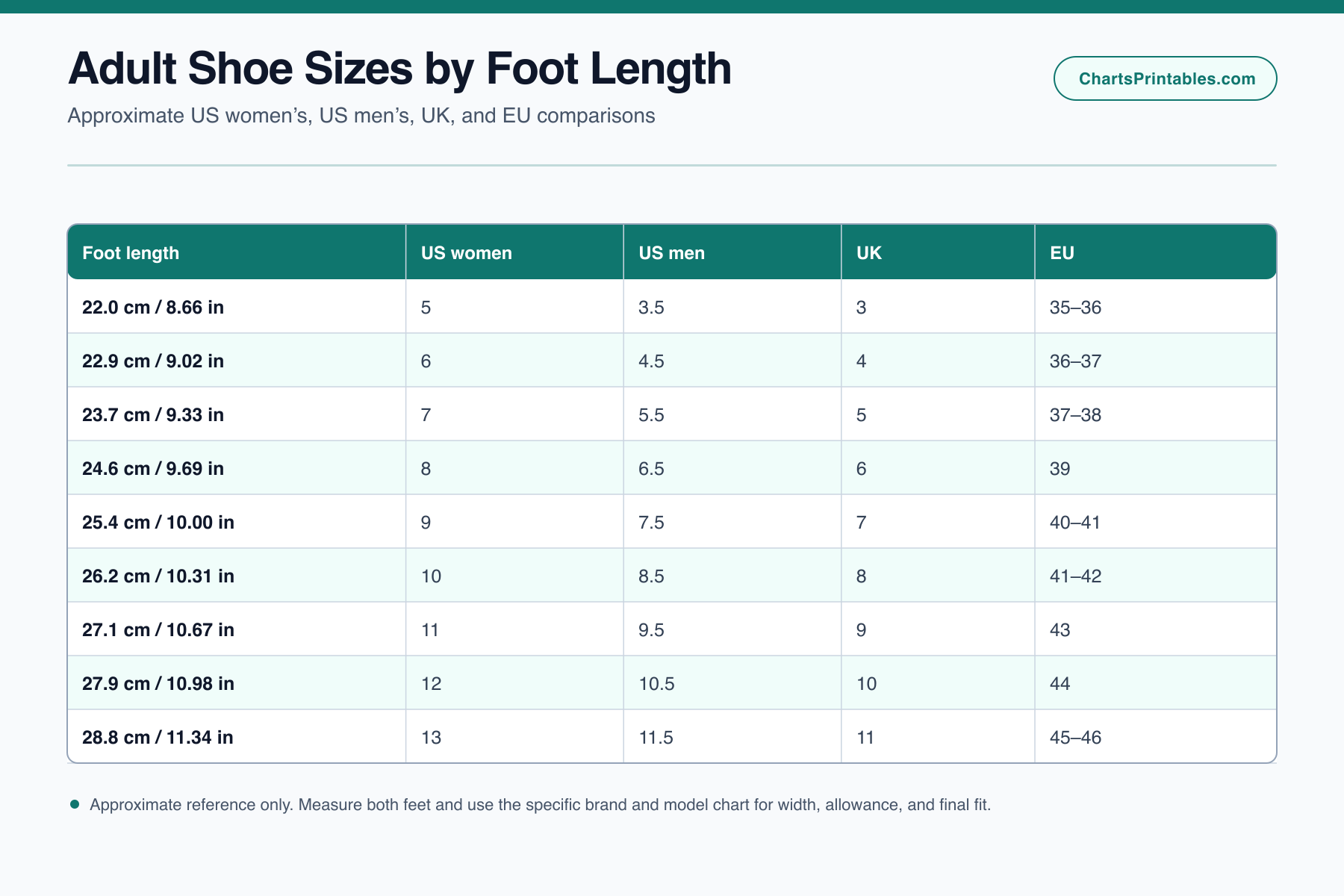
Build a shoe size chart you can use while shopping

Measure both feet, keep the larger length, and choose the matching audience in the builder. Select the regional columns you need, preview the shoe size chart, and print or export it for reference. Before ordering, compare the result with the exact seller or manufacturer chart.

A small note beside the printable can prevent confusion later: write the measured length, date, socks, and product chart checked. The chart builder handles audience, columns, paper size, orientation, preview, print, PNG, and PDF. It does not create a personal fit recommendation.

Store the shoe size chart with the date, intended socks, and product reference that informed it.

Customize the shoe size chart

Measure both feet before comparing sizes

Sources and method

The calculation and measurement boundaries on this page use the primary references below. Product-specific instructions still take priority where the page says they do.

Related charts

CM → InchesSizing helper
CentimetersMetersDecimal (in)Fraction (in)ft'-in
50.051.971 15/16"0'2"
100.103.943 15/16"0'4"
200.207.877 7/8"0'8"
300.3011.8111 13/16"1'0"
500.5019.6919 11/16"1'8"
700.7027.5627 9/16"2'4"
900.9035.4335 7/16"2'11"
1001.0039.3739 3/8"3'3"
1301.3051.1851 3/16"4'3"
1801.8070.8770 7/8"5'11"

CM to Inches Chart

Convert centimeters to inches with precision for international sizing and measurements.

Customize & Download

Frequently asked questions

How do I use a shoe size chart?

Measure both feet from the outermost heel point to the longest toe, keep the larger measurement, and compare it with the CM or JP column in the correct adult or kids table. Then check the exact seller or manufacturer chart because regional conversions and fit methods can vary.

Is a US shoe size the same as a UK shoe size?

No. US and UK labels use different scales. A shoe size chart can show common equivalents, but the relationship is approximate and can vary by audience and product. Use measured foot length and the seller's own chart before buying.

Should I use the larger foot measurement?

Yes. Measure both feet and compare the shoe size chart with the larger heel-to-toe length. If the product has width choices or model-specific fitting instructions, check those too.

Is CM or JP sizing the same as foot length?

It often provides a length-based comparison, but sellers may label or round the column differently. Keep your measured length and read the product chart's definition. Do not assume every CM or JP entry guarantees the same fit.

Can I choose a child's shoe size from age alone?

No. Age ranges are estimates, not measurements. Use them only to find a likely part of the children's shoe size chart, then measure both feet and follow the seller's kids-size categories and fit instructions.

Why can two shoes in the same size fit differently?

Models can use different lasts, widths, materials, liners, insoles, and intended fits. Socks and personal fit preference matter too. A shoe size chart compares labels and length references; it cannot predict every model's shape or comfort.

Should I always size up when I am between shoe size chart rows?

Not automatically. Keep the unrounded measurement, read how the seller defines its length column, and follow the model-specific chart. Sizing up can add unwanted length without solving a width or shape issue.

Does this shoe size chart guarantee fit?

No. It is a printable conversion and comparison reference. It does not inspect your feet, certify a product, or guarantee comfort, width, or suitability. Confirm the result with the seller or manufacturer and try the shoe on when possible.