Quick reference
These values land exactly on 1/8-inch increments, so they remain exact in every supported denominator view: 0.1250 = 1/8, 0.2500 = 1/4, 0.3750 = 3/8, 0.5000 = 1/2, 0.7500 = 3/4 and 0.8750 = 7/8.
Printable reference + builder
Use this decimal to fraction inches chart to convert an inch decimal to the nearest fraction at 1/8, 1/16, 1/32 or 1/64-inch precision. A result is exact only when the original decimal equals the fraction’s decimal value. Otherwise, the fraction is rounded and must be shown with its rounded value and absolute difference.
The selected denominator sets the lookup interval; it is not a project tolerance and does not improve the measurement. Keep the original decimal as the controlling value whenever a drawing, inspection plan, machining process or part specification requires more information than the chosen fraction can preserve.
Quick answer
Quick reference
These values land exactly on 1/8-inch increments, so they remain exact in every supported denominator view: 0.1250 = 1/8, 0.2500 = 1/4, 0.3750 = 3/8, 0.5000 = 1/2, 0.7500 = 3/4 and 0.8750 = 7/8.
Optional millimeters use exactly 25.4 millimeters per inch: the values are 3.175, 6.350, 9.525, 12.700, 19.050 and 22.225 mm. A displayed decimal may be rounded for presentation, so retain the source value when downstream precision matters. These quick answers use the same calculation method as the main chart.
Choose start and end values, then select 1/8, 1/16, 1/32 or 1/64. The builder generates denominator-aligned rows; it is not an arbitrary-decimal fit calculator. Browser Print and available PDF or PNG options follow the current quota and Terms. Exported rows do not certify tolerance, fit or machining suitability.
Woodworking • 1/64" • 0-1" • 1 page • portrait
ChartsPrintables.com
Precision: 1/64" • Range: 0" - 1" • With Millimeters
| Decimal | Fraction | Millimeters |
|---|---|---|
| 0.0000 | 0" | 0.000 |
| 0.0156 | 1/64" | 0.397 |
| 0.0313 | 1/32" | 0.794 |
| 0.0469 | 3/64" | 1.191 |
| 0.0625 | 1/16" | 1.587 |
| 0.0781 | 5/64" | 1.984 |
| 0.0938 | 3/32" | 2.381 |
| 0.1094 | 7/64" | 2.778 |
| 0.1250 | 1/8" | 3.175 |
| 0.1406 | 9/64" | 3.572 |
| 0.1563 | 5/32" | 3.969 |
| 0.1719 | 11/64" | 4.366 |
| 0.1875 | 3/16" | 4.762 |
| 0.2031 | 13/64" | 5.159 |
| 0.2188 | 7/32" | 5.556 |
| 0.2344 | 15/64" | 5.953 |
| 0.2500 | 1/4" | 6.350 |
| 0.2656 | 17/64" | 6.747 |
| 0.2813 | 9/32" | 7.144 |
| 0.2969 | 19/64" | 7.541 |
| 0.3125 | 5/16" | 7.938 |
| 0.3281 | 21/64" | 8.334 |
| 0.3438 | 11/32" | 8.731 |
| 0.3594 | 23/64" | 9.128 |
| 0.3750 | 3/8" | 9.525 |
| 0.3906 | 25/64" | 9.922 |
| 0.4063 | 13/32" | 10.319 |
| 0.4219 | 27/64" | 10.716 |
| 0.4375 | 7/16" | 11.112 |
| 0.4531 | 29/64" | 11.509 |
| 0.4688 | 15/32" | 11.906 |
| 0.4844 | 31/64" | 12.303 |
| 0.5000 | 1/2" | 12.700 |
| 0.5156 | 33/64" | 13.097 |
| 0.5313 | 17/32" | 13.494 |
| 0.5469 | 35/64" | 13.891 |
| 0.5625 | 9/16" | 14.287 |
| 0.5781 | 37/64" | 14.684 |
| 0.5938 | 19/32" | 15.081 |
| 0.6094 | 39/64" | 15.478 |
| 0.6250 | 5/8" | 15.875 |
| 0.6406 | 41/64" | 16.272 |
| 0.6563 | 21/32" | 16.669 |
| 0.6719 | 43/64" | 17.066 |
| 0.6875 | 11/16" | 17.462 |
| 0.7031 | 45/64" | 17.859 |
| 0.7188 | 23/32" | 18.256 |
| 0.7344 | 47/64" | 18.653 |
| 0.7500 | 3/4" | 19.050 |
| 0.7656 | 49/64" | 19.447 |
| 0.7813 | 25/32" | 19.844 |
| 0.7969 | 51/64" | 20.241 |
| 0.8125 | 13/16" | 20.637 |
| 0.8281 | 53/64" | 21.034 |
| 0.8438 | 27/32" | 21.431 |
| 0.8594 | 55/64" | 21.828 |
| 0.8750 | 7/8" | 22.225 |
| 0.8906 | 57/64" | 22.622 |
| 0.9063 | 29/32" | 23.019 |
| 0.9219 | 59/64" | 23.416 |
| 0.9375 | 15/16" | 23.813 |
| 0.9531 | 61/64" | 24.209 |
| 0.9688 | 31/32" | 24.606 |
| 0.9844 | 63/64" | 25.003 |
| 1.0000 | 1" | 25.400 |
Formula: fraction = decimal × denominator
Decimals
65
Precision
1/64" • 0-1"
PDF FILE SIZE
≈0KB
Quality
300 DPI
Export Set
One setup, every version you need.
Classroom fraction pack
Seven complete references in Letter + A4, plus an index and classroom use notes.
Visual quick reference
0.125 inch is 1/8 inch, 0.25 is 1/4 inch, 0.5 is 1/2 inch, and 0.75 is 3/4 inch.
The visual chart pairs common workshop decimals with exact fractions and millimeter equivalents. For a decimal that falls between listed values, choose a denominator and round only to the precision the job permits.
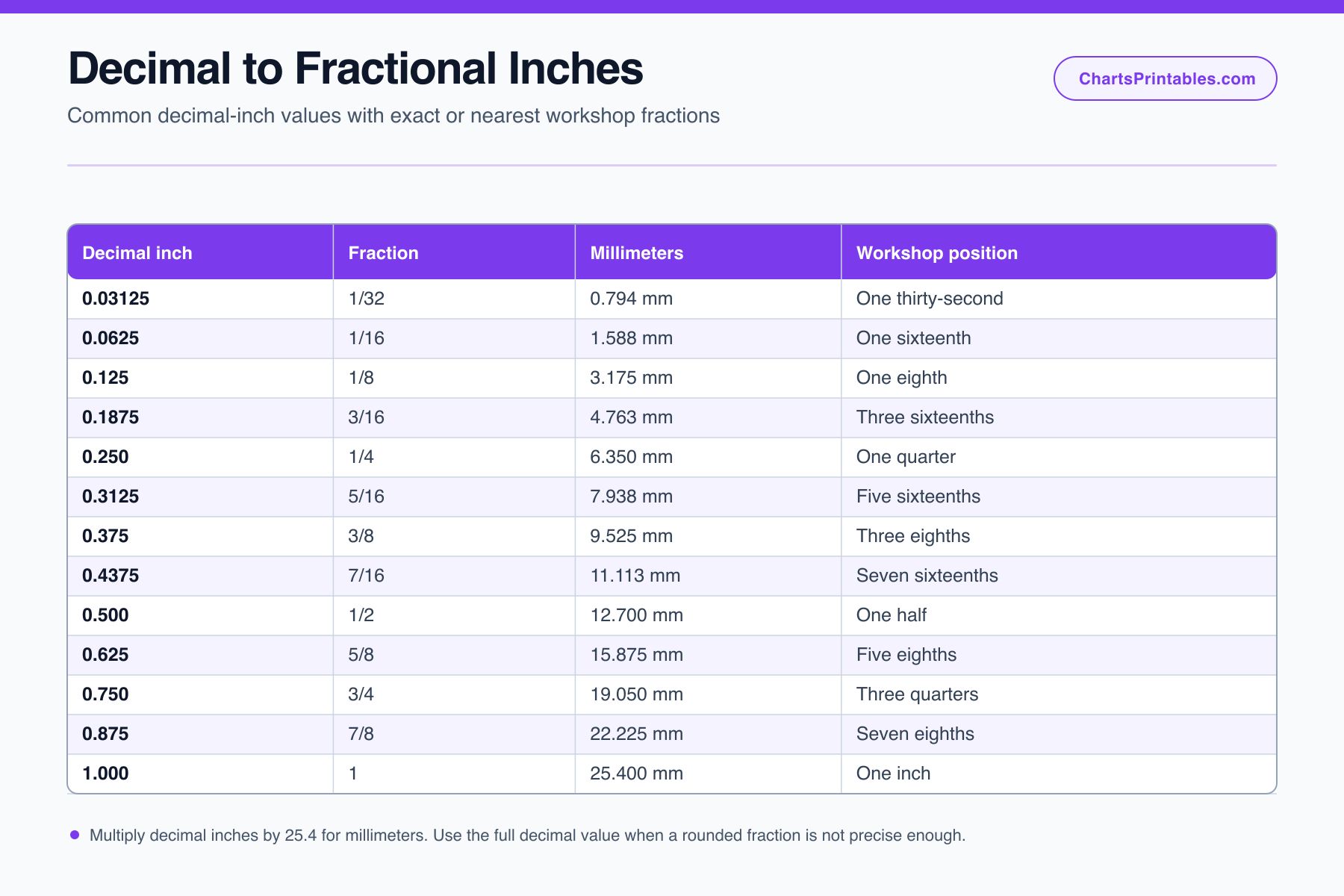
Use these when a coarse physical scale or familiar shop fraction is the task. Their intervals are 0.125 and 0.0625 inch. Compare the interval with the actual marks and external requirement before replacing the decimal.
Their intervals are 0.03125 and 0.015625 inch. A smaller interval can reduce rounding difference, but extra digits do not add accuracy to a rough measurement.
The denominator limits available fractions; a drawing, specification or process defines acceptable error. This decimal to fraction inches workflow reports the delta but never approves it.
For 0.343 inch at 1/32, the nearest mark is 11/32 or 0.34375, with a 0.00075-inch delta. Keep 0.343 in notes when the source dimension controls.
Preserve the original decimal and units. A caliper display is a measurement, not a tolerance statement. Use a fraction as an annotation only after the drawing owner’s tolerance and rounding convention are known.
Use the nearest fraction to locate a candidate, then compare the actual part, hole, bit standard and required clearance. Similar values do not approve substitution or fit. Retain the decimal when ordering or inspection documents specify it.
For selected denominator d, calculate n = round(decimal × d). The rounded value is n ÷ d, and absolute delta is |original − rounded value|. Reduce n/d with the greatest common divisor. For values above one inch, separate the whole number and simplify the remainder.
Label output exact only when delta is zero. Otherwise label it nearest or rounded and display rounded decimal plus delta. If a value is exactly halfway, the chart’s stated rounding convention controls.
This method makes decimal to fraction inches results reproducible. It cannot determine whether delta satisfies an external tolerance, whether the measurement is reliable or whether a part will fit.
Rounded example: at denominator 32, n = round(0.343 × 32) = round(10.976) = 11. The result is 11/32 or 0.34375. Absolute delta is |0.343 − 0.34375| = 0.00075 inch.
Rounded example: at denominator 64, n = round(0.201 × 64) = round(12.864) = 13. The result is 13/64 or 0.203125. Absolute delta is |0.201 − 0.203125| = 0.002125 inch. Neither rounded result states acceptable tolerance.
Method & limits
Choose a denominator of 8, 16, 32, or 64. The chart rounds to the nearest numerator, reduces the fraction with the greatest common divisor, and uses exactly 25.4 millimeters per inch. Label the result exact only when its decimal value equals the original; otherwise show the rounded value and absolute difference. Contact us if you find a calculation that needs correction.
The controlling decimal, instrument resolution, repeatability, and external tolerance remain outside this lookup. Denominator choice does not create a tolerance, and a caliper reading does not approve fit or machining suitability. Decimal to fraction inches output is a representation choice, not acceptance evidence. Check the controlling requirement before using the result.
Use the related charts below to reverse the conversion, convert metric inputs, compare a candidate drill size, or convert the controlling inch value to millimeters. These pages support lookup; they do not establish tolerance or fit.
Keep the original unit and value when moving between tools. Record the denominator, rounded decimal, and delta beside any transferred fraction so another person can reproduce the choice. If the destination chart uses a different rounding rule or displayed precision, recalculate instead of copying the earlier result. This keeps the conversion trail reviewable without treating a nearby row as acceptance.
| Fraction | Decimal | MM |
|---|---|---|
| 1/64" | 0.0156 | 0.40 |
| 1/32" | 0.0313 | 0.79 |
| 1/16" | 0.0625 | 1.59 |
| 1/8" | 0.1250 | 3.18 |
| 3/16" | 0.1875 | 4.76 |
| 1/4" | 0.2500 | 6.35 |
| 5/16" | 0.3125 | 7.94 |
| 3/8" | 0.3750 | 9.53 |
| 1/2" | 0.5000 | 12.70 |
| 5/8" | 0.6250 | 15.88 |
Reverse the lookup from a fraction to its decimal value.
Customize & Download| Millimeters | Decimal (in) | Fraction (in) |
|---|---|---|
| 0.5 | 0.020 | 0 |
| 1 | 0.039 | 1/16 |
| 6.35 | 0.250 | 1/4 |
| 12.7 | 0.500 | 1/2 |
| 19 | 0.748 | 3/4 |
| 25.4 | 1.000 | 1 |
| 38.1 | 1.500 | 1 1/2 |
| 50.8 | 2.000 | 2 |
| 76.2 | 3.000 | 3 |
| 101.6 | 4.000 | 4 |
| Number | Fraction | Decimal (in) | Millimeters |
|---|---|---|---|
| #80 | — | 0.0135 | 0.34 |
| #50 | — | 0.0700 | 1.78 |
| #52 | 1/16" | 0.0625 | 1.59 |
| #41 | 3/32" | 0.0938 | 2.38 |
| #22 | 5/32" | 0.1562 | 3.97 |
| #11 | 3/16" | 0.1875 | 4.76 |
| #7 | 13/64" | 0.2031 | 5.16 |
| — | — | 0.2570 | 6.53 |
| — | 3/8" | 0.3750 | 9.53 |
| — | 1/2" | 0.5000 | 12.70 |
| Inches (fraction) | Inches (decimal) | Millimeters | Centimeters |
|---|---|---|---|
| 1/4" | 0.250 | 6.35 | 0.64 |
| 1/2" | 0.500 | 12.70 | 1.27 |
| 1" | 1.000 | 25.40 | 2.54 |
| 1 1/2" | 1.500 | 38.10 | 3.81 |
| 2" | 2.000 | 50.80 | 5.08 |
| 2 1/2" | 2.500 | 63.50 | 6.35 |
| 3" | 3.000 | 76.20 | 7.62 |
| 4" | 4.000 | 101.60 | 10.16 |
| 5" | 5.000 | 127.00 | 12.70 |
| 6" | 6.000 | 152.40 | 15.24 |
Choose a denominator, compute round(decimal × denominator), reduce with the greatest common divisor, and compare numerator ÷ denominator with the original. Report absolute delta whenever the result is rounded.
Use the nearest row only as a rounded reference. Display its decimal value and absolute difference. Keep the original decimal if a drawing, tolerance or inspection requirement controls.
Match the denominator to the scale and communication task. Smaller intervals can reduce rounding difference, but do not increase measurement accuracy or define acceptable tolerance.
Only when its decimal value equals the original. If values differ, call the fraction nearest or rounded and show the delta rather than presenting it as exact.
Convert the fraction back to decimal, then calculate |original − rounded|. For 0.343 to 11/32, this is |0.343 − 0.34375| = 0.00075 inch.
Keep it when a drawing, instrument, ordering record, process or inspection plan uses the decimal as controlling value, or whenever the fraction hides more difference than the external requirement allows.